Earth. Our one and only home. Forget about going boldly where no one has gone before, this is it. Even if we were to find another suitable planet for our existence, history suggests we would strip it of its resources and fight over who gets to claim ownership.
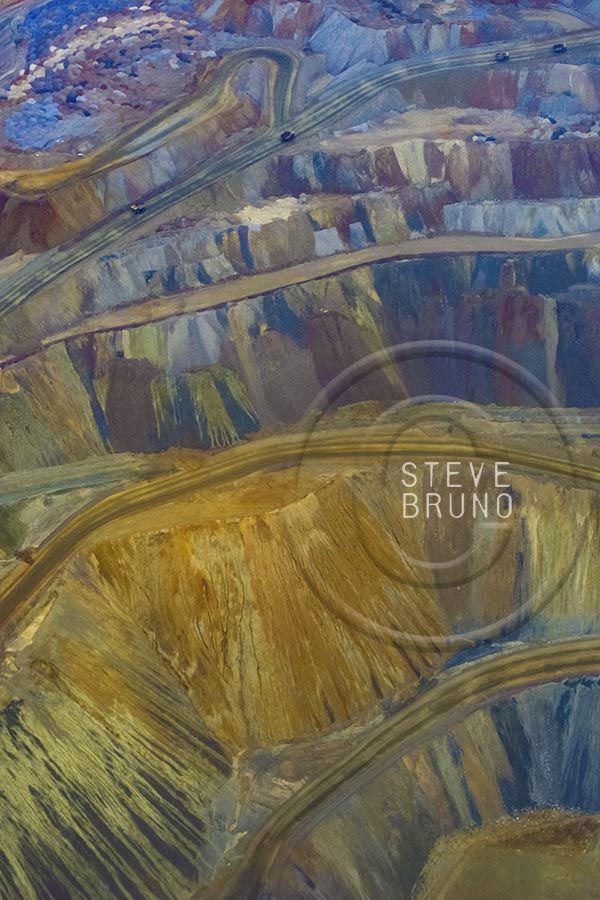
Many civilizations have proven it’s possible to live within the means of the local environment, but our modern society has created demands which leave tremendous scars on our planet. Forest clearcutting and strip mining would be major examples of this. Copper, a material we have made essential to our way of living, does not exist in large, solid masses, so can only be extracted through the process of strip mining.
For this week’s challenge, I could have chosen one of many images which I feel portray the special qualities and beauty of this planet. I kept coming back to this one, however. Earth has this magical quality of rejuvenation, and after we have vanished, will reclaim itself.
This is my hands-down favorite image ever taken from an airplane. On an early morning flight into Salt Lake City, we passed the Kennecott open pit mine. After copper is exposed, the oxidation process turns it into a complexity of colors. This should have been a blight on the land, but all I can see is beauty in this shot.
Need a frame of reference? Along the line extending to the upper right corner, you will see four dots. Each of those is a truck capable of moving hundreds of tons of dirt, and having tires that are taller than a semi-trailer.
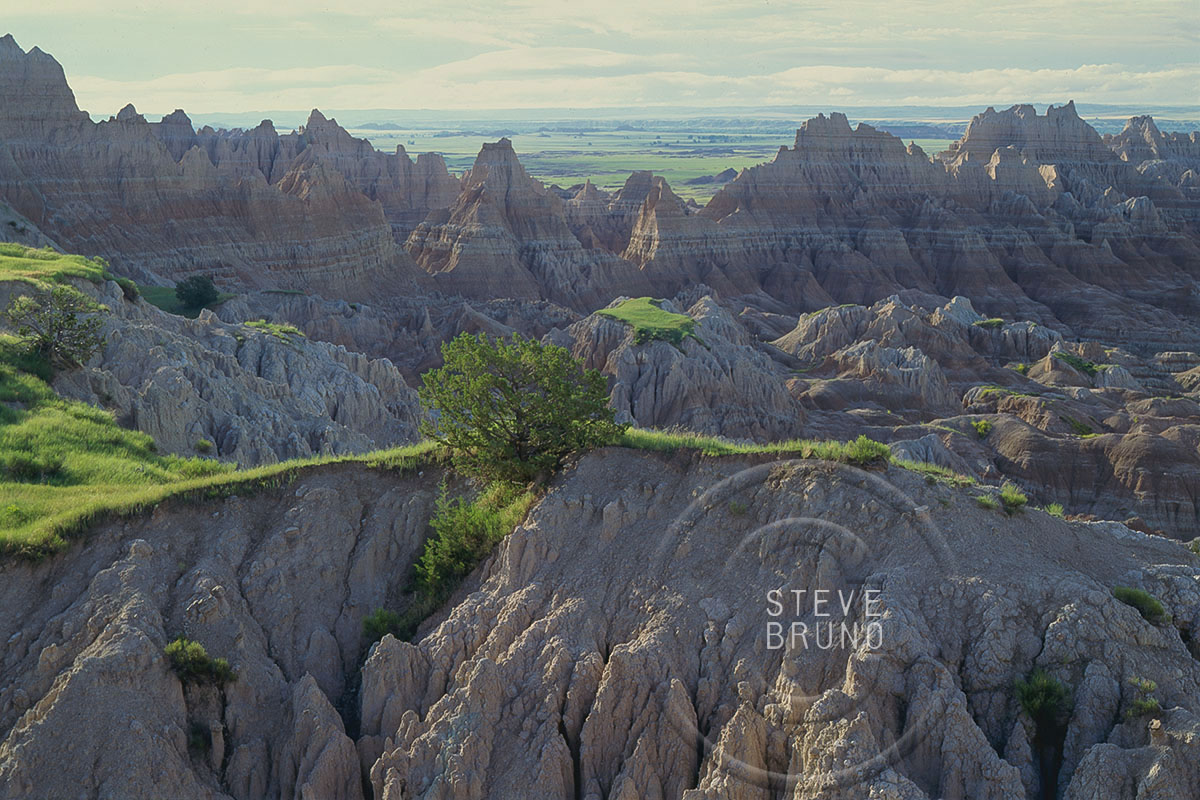
This week’s challenge of Landscape should have been a no-brainer, with the only dilemma being which one? A glance through my blog will reveal many shots of the nearby desert, but there are a couple places in the US that I love to photograph which are miles away from here. The state of South Dakota, in particular the Black Hills and Badlands National Park, would be near the top of that list.
A few years back, my work was in a gallery where the owner was interested in testing out new images. Unfortunately, this was in a town with many golf courses nearby, and after a couple weeks, he took this one down because people kept commenting, “What a great place that would be to put a golf course”. Hopefully, the blogging community will appreciate this one more than the golfers!
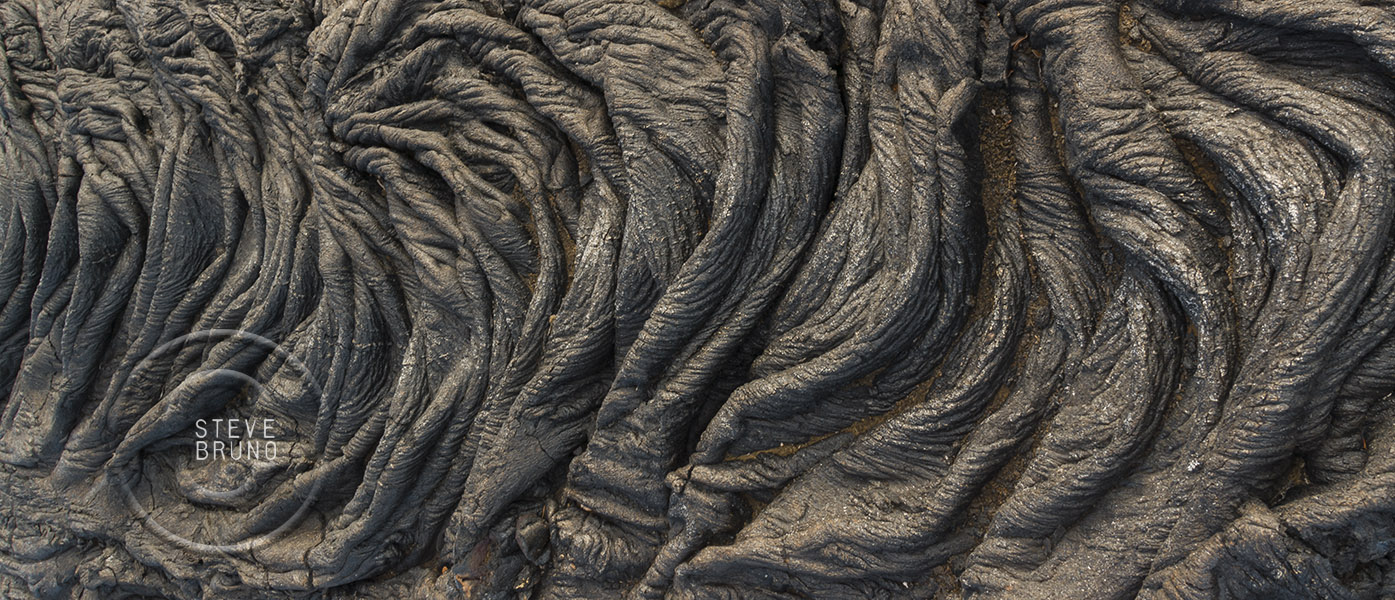
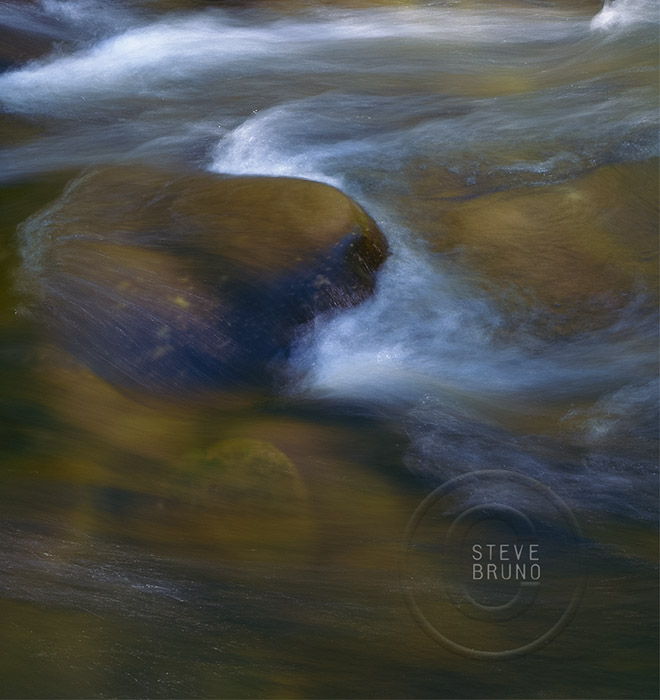
For this week’s challenge of Dance, I almost took the easy route with photos of people dancing, but then remembered the operative word is challenge. You’ll probably enjoy these a bit more, anyway. I know I do.
For anyone who has ever witnessed a slow lava flow, you know there is a pulse that surges, as the cool air solidifies the flow, while the warm undercurrent wants to keep moving. The final cooled result (above) reflects that pulse, and was taken in Hawaii Volcanoes National Park.
Flowing, tumbling water can also have a rhythmic feel to it. The sunlight was being filtered through the forest, and accentuated most of the current in this shot of Oak Creek, near Sedona, Arizona.
Clouds can portray a feeling of choreography, even in a still capture. My favorite example is this thunderstorm at sunset near Cloudcroft, New Mexico.
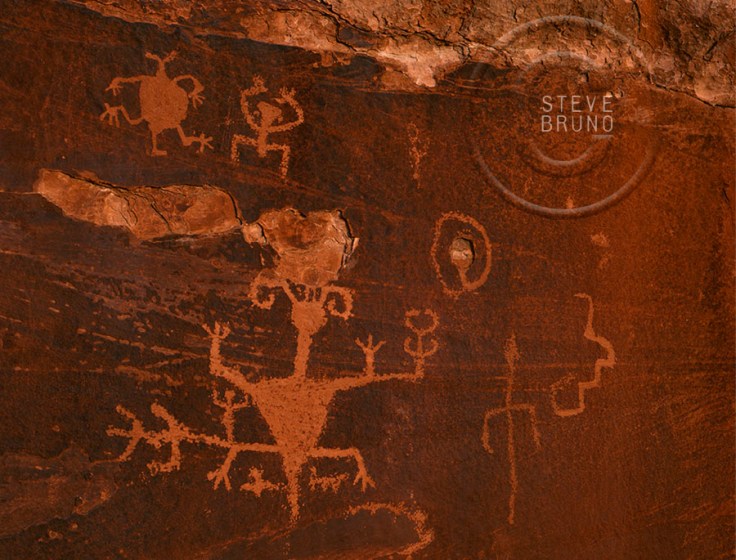
Finally, rock art symbols almost always have a sense of dance and celebration, indicating how important this was in ancient culture. This panel of rock art is in the Grand Canyon.
WordPress recently informed me that I have been on their site for a year now. To those of you who have followed, liked, commented or enjoyed my posts – Thank You!
It was a little over a year ago when I was spending way too much time on a computer because a leg injury was keeping me inactive. Those who know me know I don’t do well at sitting. I came across a page that explained why photographers should start a blog and listed some sites. I really had no idea what I was getting into, but I have a lot of photographs that never made publication, and many that have a story behind them. I was always disappointed when I came across other photographer’s websites and saw interesting images that had no words to convey the thoughts, motivation or process behind the image.
I suppose I should start with my title. Quite a few years ago, I had the chance to meet with Josef Muench. Josef was one of the pioneers of modern day landscape photography, and around that time an editor told me that Josef was still submitting photos to the magazine, some of which couldn’t be used because the emulsion had started to degrade. As I was talking with Josef, I asked him, “Out of all your photographs, which is your favorite?” He responded quickly with “The one I haven’t taken yet!” He was an inspiration with his images, but even more so with his philosophy. I want to reach that age and continue taking photographs that I still care about. That’s where the name Gottatakemorepix got its initiation.
I had a couple stories that I wanted to write when I first started, but I wasn’t sure how long I would keep this going. Then I started noticing blog posts that all had the words “Weekly Photo Challenge” in the title, and soon began posting those. I’ve participated in other blogger’s challenges, and as much as I enjoy seeing what other people respond with, I never knew how time consuming this could become. I also noticed a lot of people posting “Wordless Wednesday”. After doing a couple of these myself, I thought I can’t do this…I need words. So my alternative is Mid-week Mixings. This allows me to get away with Tuesday, Wednesday, or Thursday, too! To those of you that post every day, my hat’s off to you – I don’t know how you do it.
If you don’t see a post from me for a while, it’s a good bet that I’m travelling or just plain busy. My priorities are still real life, family, and friends before cyberspace. My end of December and beginning of January were way too busy to do a 2015 recap, so I’m going to do it here.
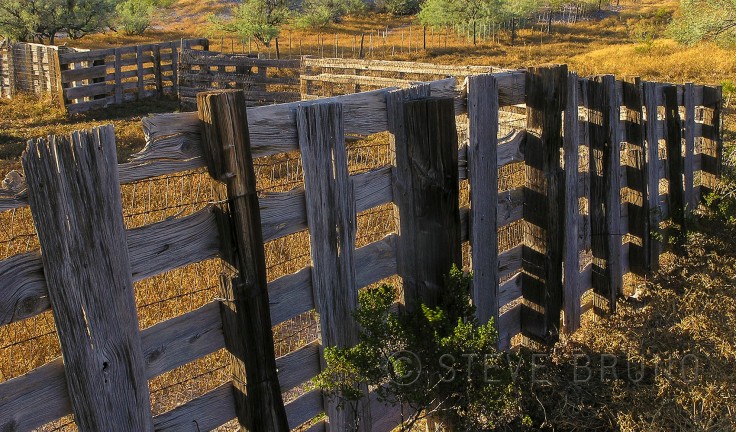
Old fence on a ranch in the desert, photo by Steve Bruno
While the most liked/commented images were in the Daily Post’s Challenges, many of you enjoyed these images from one of Cee’s Challenges
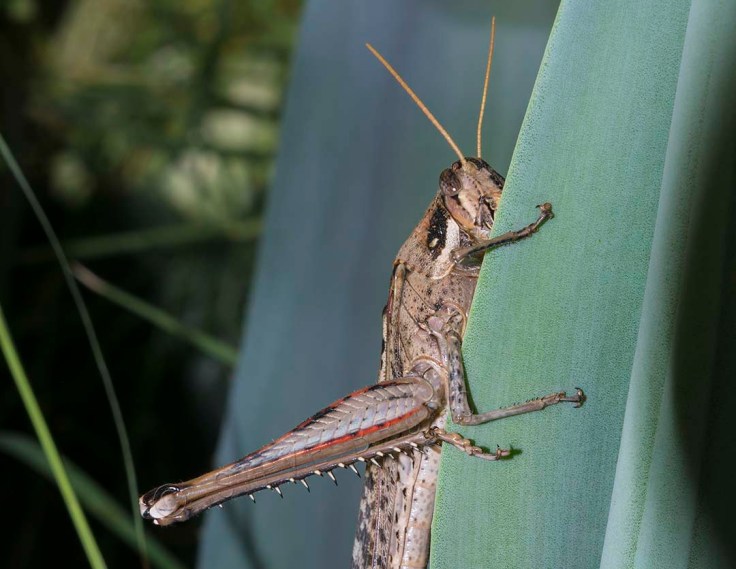
This grasshopper shot was another challenge that the blogging community seemed to enjoy
grasshopper clings to agave plant, photo by Steve Bruno
The Daily Post’s Symbol challenge gave me a reason to go out and photograph something that everybody and their brother has a shot of, and when I got there, I discovered more subjects fitting the challenge
Elvis impersonator performs under the Las Vegas sign. Photo by Steve Bruno
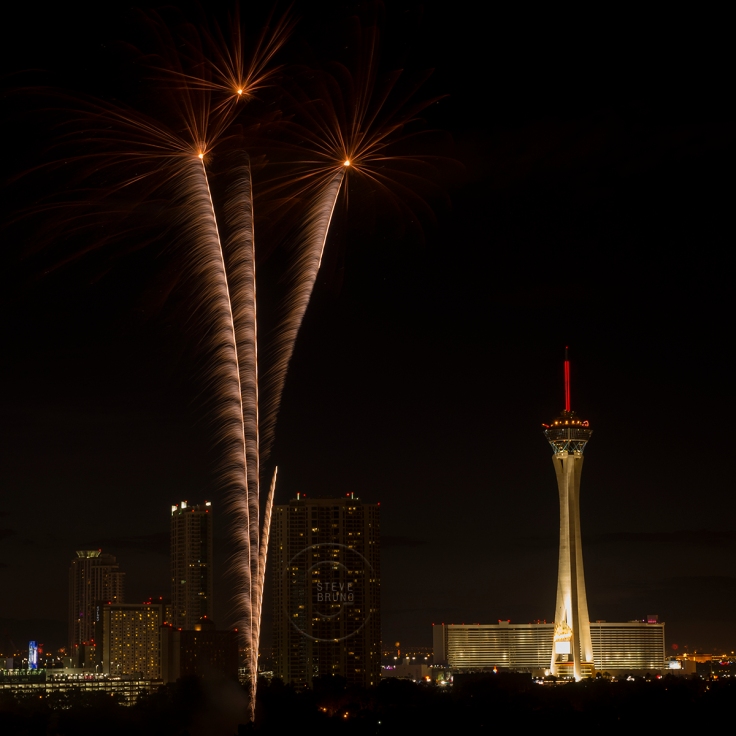
Although not a challenge, but close to home, I enjoyed capturing fireworks last summer
Las Vegas Fireworks July 2015. Photo by Steve Bruno.
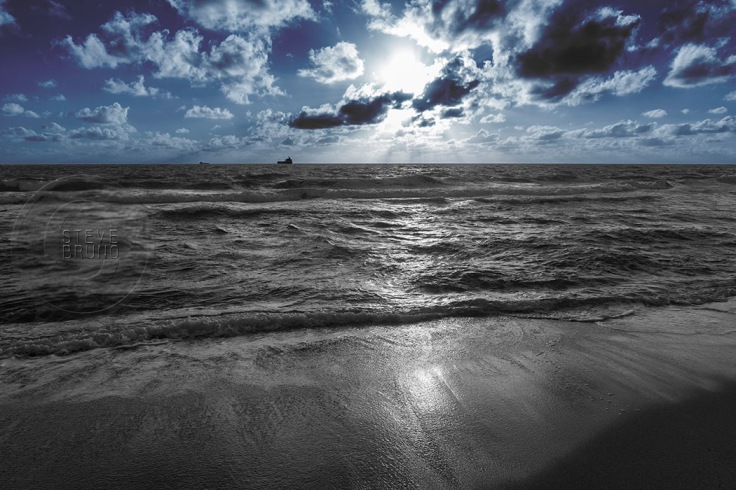
Away from the challenges, this one was a little departure for me, but has become one of my favorites, as well as yours
The Atlantic Ocean in early morning. Photo by Steve Bruno.
I’m sure I’ve mentioned it before that I really don’t enjoy shooting with clear blue skies, but I found a situation where it worked well
Crescent moon in the skies above an ocotillo plant in the Arizona desert by Steve Bruno
Late season bloom of yucca plants, as twilight approaches, in the Arizona desert by Steve Bruno
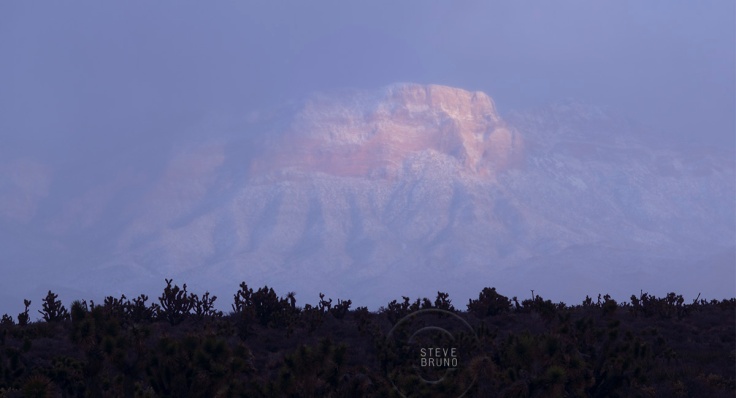
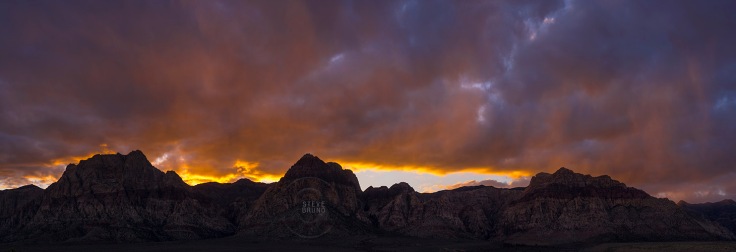
Weather is a little more to my liking for taking photos, and I showed this in one of my first posts of the year. I don’t know what grinder WordPress uses to compress images, but the first time I posted it did not look as good as it does on my screen. I like unique captures, and this is a favorite so far this year, and hopefully it looks better this time
A window of sunlight shines through clouds in Red Rock Canyon, Nevada. Photo by Steve Bruno
Sunset over Red Rock Canyon, Nevada. Photo by Steve Bruno.
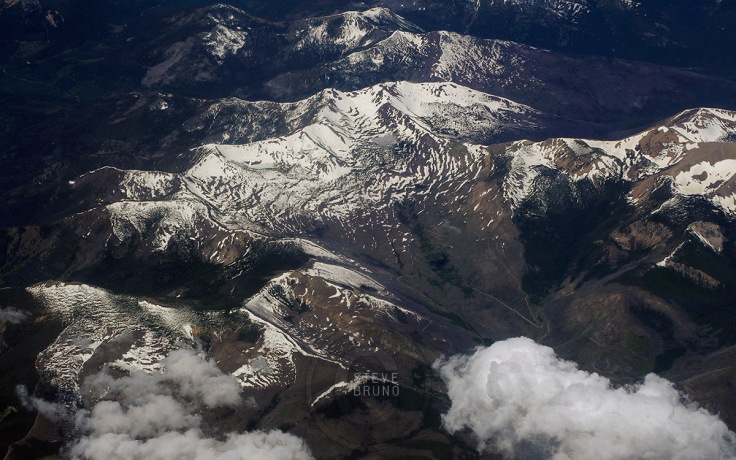
You know by now that I can’t resist the view out of airplane windows, and I have plenty of those from last year. Here’s one more that you haven’t seen yet. Over Montana, I believe
Aerial view over the Rocky Mountains. Photo by Steve Bruno.
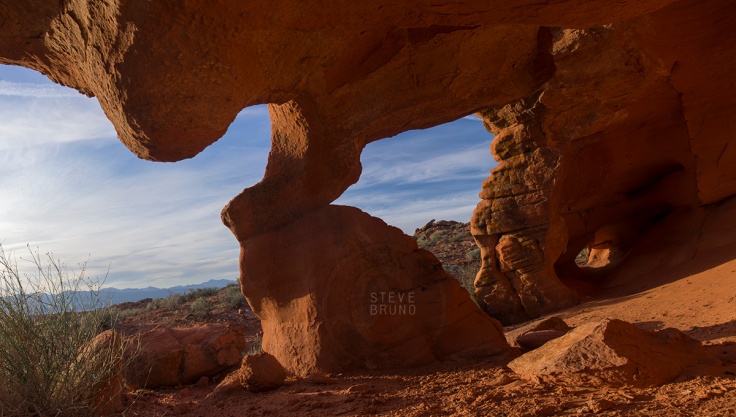
I can’t go a year without returning to my Muse, and here’s one from last year at Valley of Fire State Park
Sandstone cave in Valley of Fire State Park, Nevada. Photo by Steve Bruno.
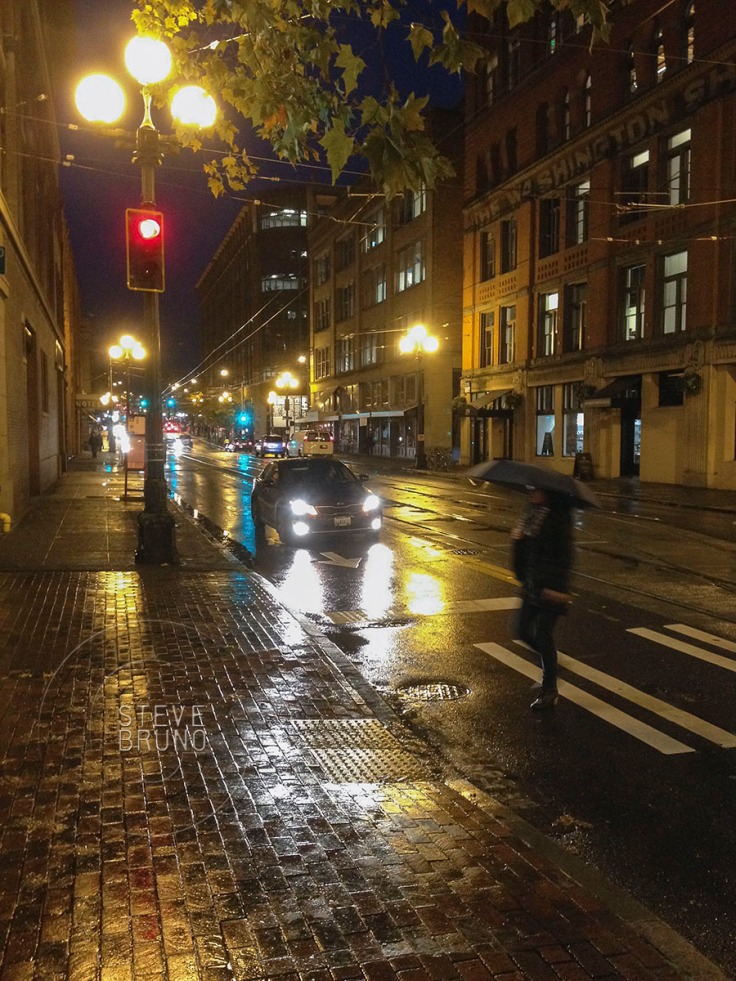
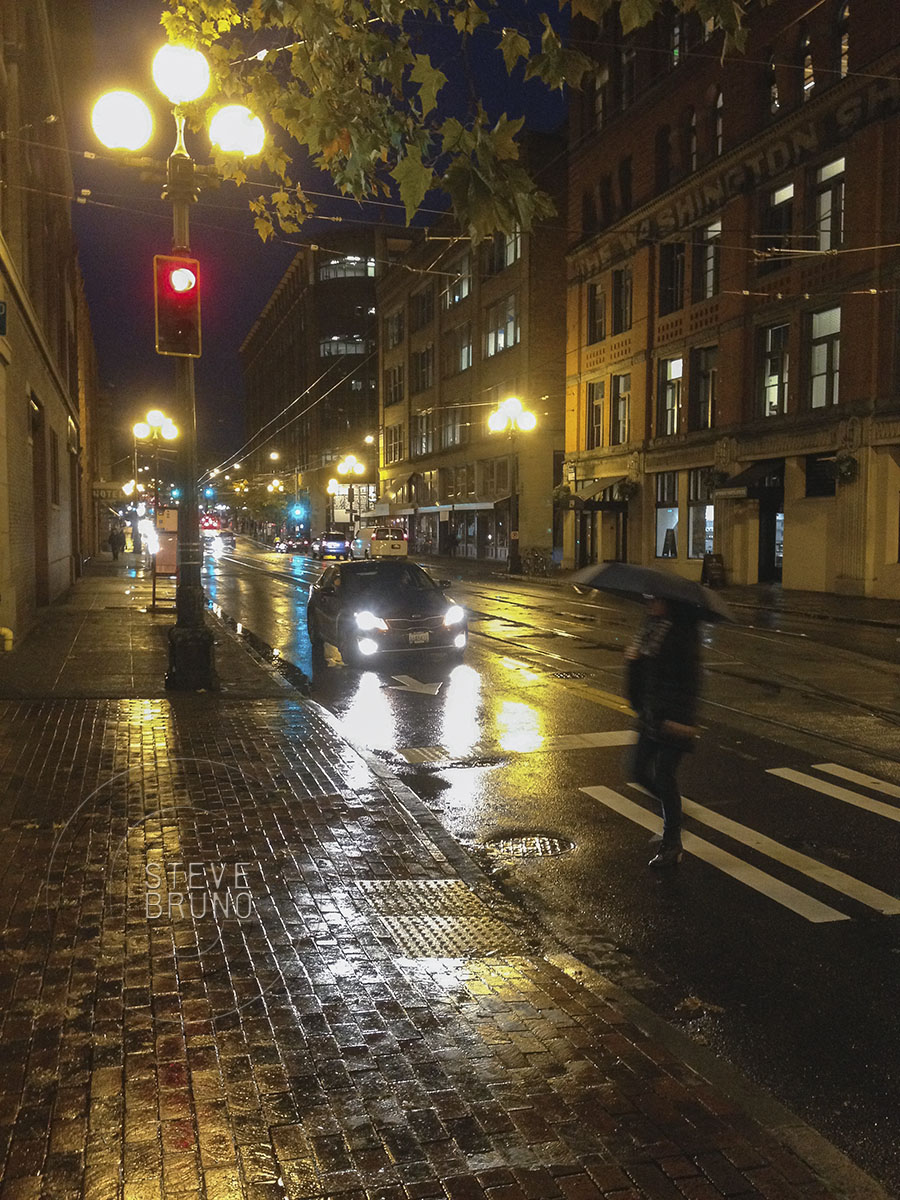
And lastly, I know phone cameras have improved, but I still consider my DSLR my real camera. My shots in the rain in Seattle last November started making me appreciate the phone a little more
Pedestrian in the nighttime rain in Seattle. Photo by Steve Bruno.
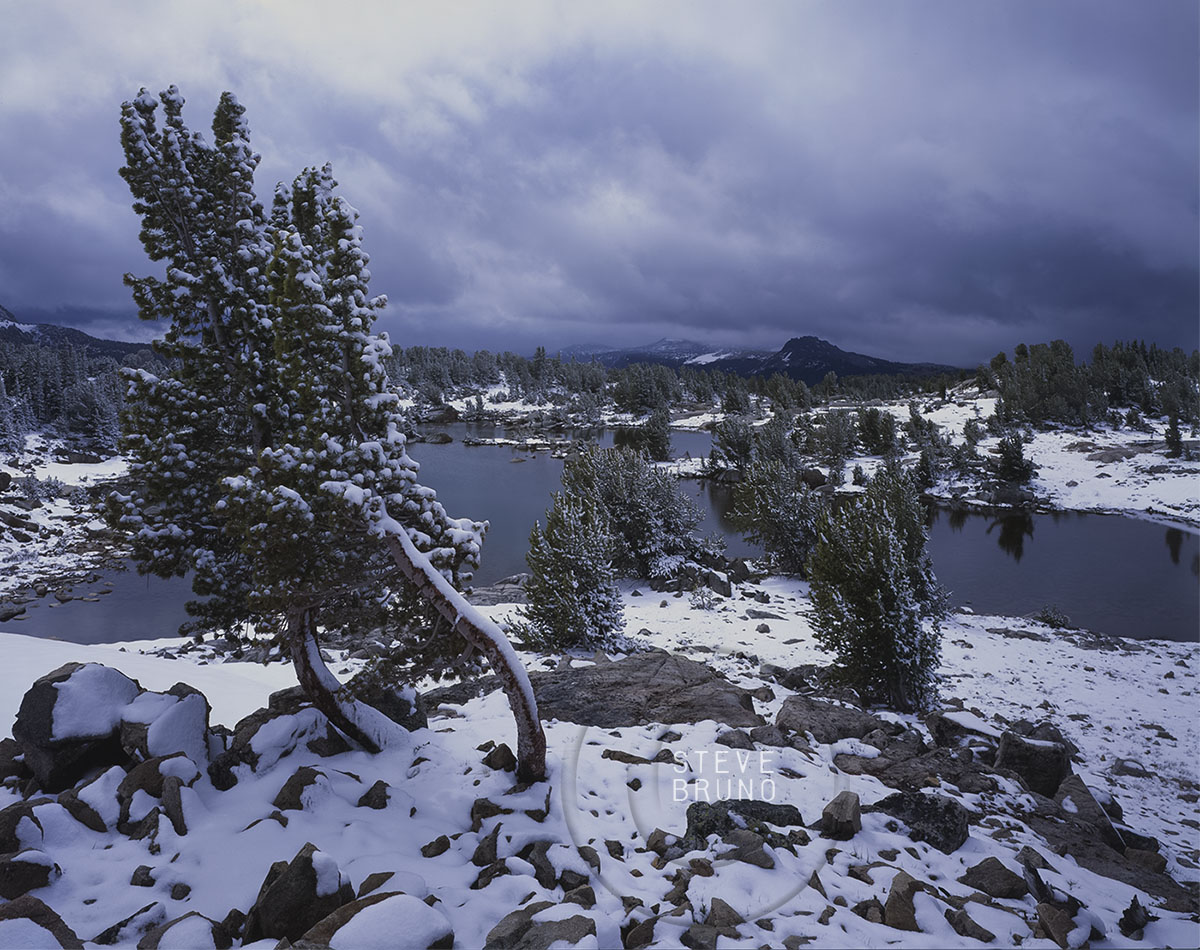
On my first visit to Yellowstone National Park, I entered the park via the Beartooth Highway, on the northeast side. When I started in the morning, it had been relatively sunny and warm, but by the time I reached the road’s summit, winter conditions prevailed. This was in the 2nd week of July.
The snow had started to accumulate to at least a couple inches, and the clouds made visibility very poor. This mountain road turns and climbs to an elevation well above treeline. What I remember most was the lack of a guardrail, and the eerie bamboo poles stuck into the ground at the road’s edge – a guide for the plows to find the road when their time came.
I had been in 4wd, and I’m sure my top speed was no more than 25mph. At one point I came across a fairly long section of straightaway and decided to test the braking ability ever so lightly. As I did, I could feel there was no traction underneath and I started to slide a little towards the downhill side. That was the last time I made any attempts at braking, and slowed my pace even further. Although not a sheer cliff, the mountainside sloped downward at least 1000 feet, and if I rolled off, it would have been at least a day before anyone would have found me. I found out later that the road was closed minutes after I started my ascent, which explained why I was the only one out there that day.
Upon descending back to the forested regions, I came across this small lake and pulled over. By now, I was just glad to have something flat on the side of the road, and having that crazy drive over the mountain pass behind me. I remember feeling so much more relaxed when I got out. This scene, with the calm lake, and the storm clouds moving out, echoed my state of mind at the time.
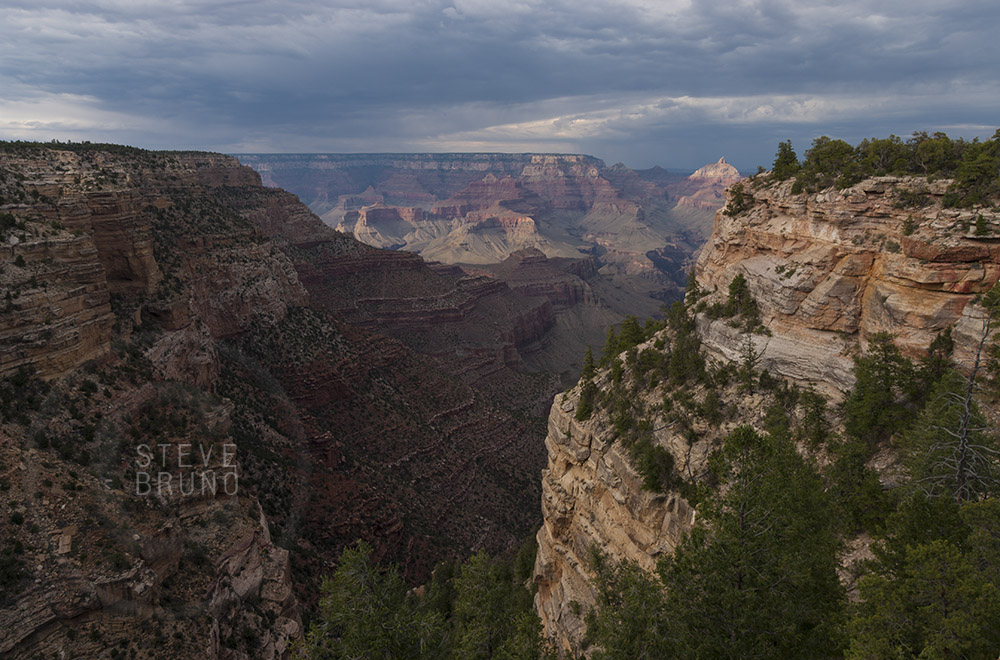
Although there are new studies which are saying the Grand Canyon may be much older, it is generally believed that the Grand Canyon is over 5 million years in the making. This is the first place I thought of when seeing this week’s Daily Post challenge of Time.
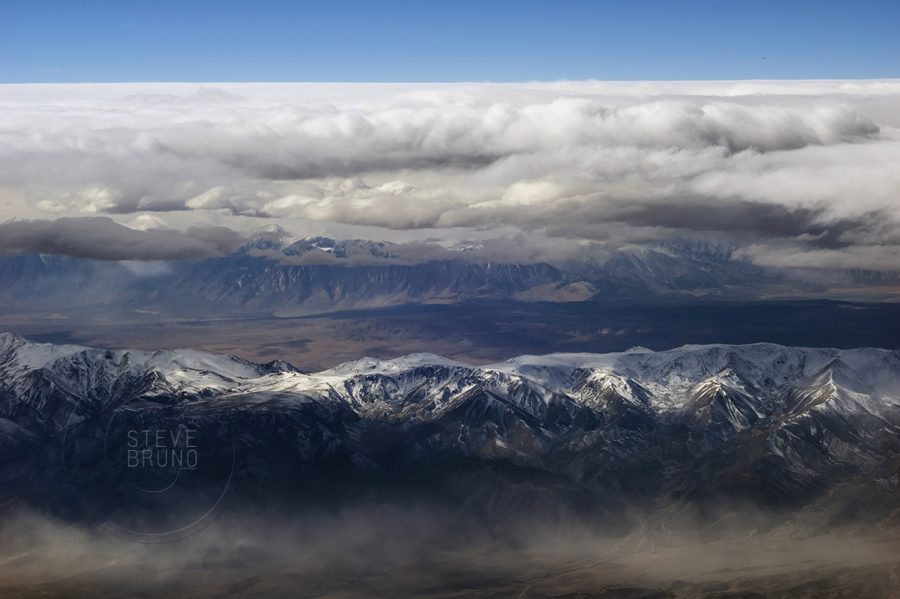
The territory covered on the flight from Las Vegas to Seattle can be quite spectacular, and my recent trip along this route coincided with the arrival of a storm front that allowed me to capture some of my favorite images ever from the air. We had passed Death Valley and still hadn’t reached full altitude when we came across this scene. I probably would have been thrilled to be on the ground for this one, especially if I were close to one of the snow-capped ridges in the distant range. Stepping back and seeing the whole picture can be good once in a while, and in this case, seeing below the clouds and the top of the approaching front made for a unique perspective I was glad I was able to photograph.
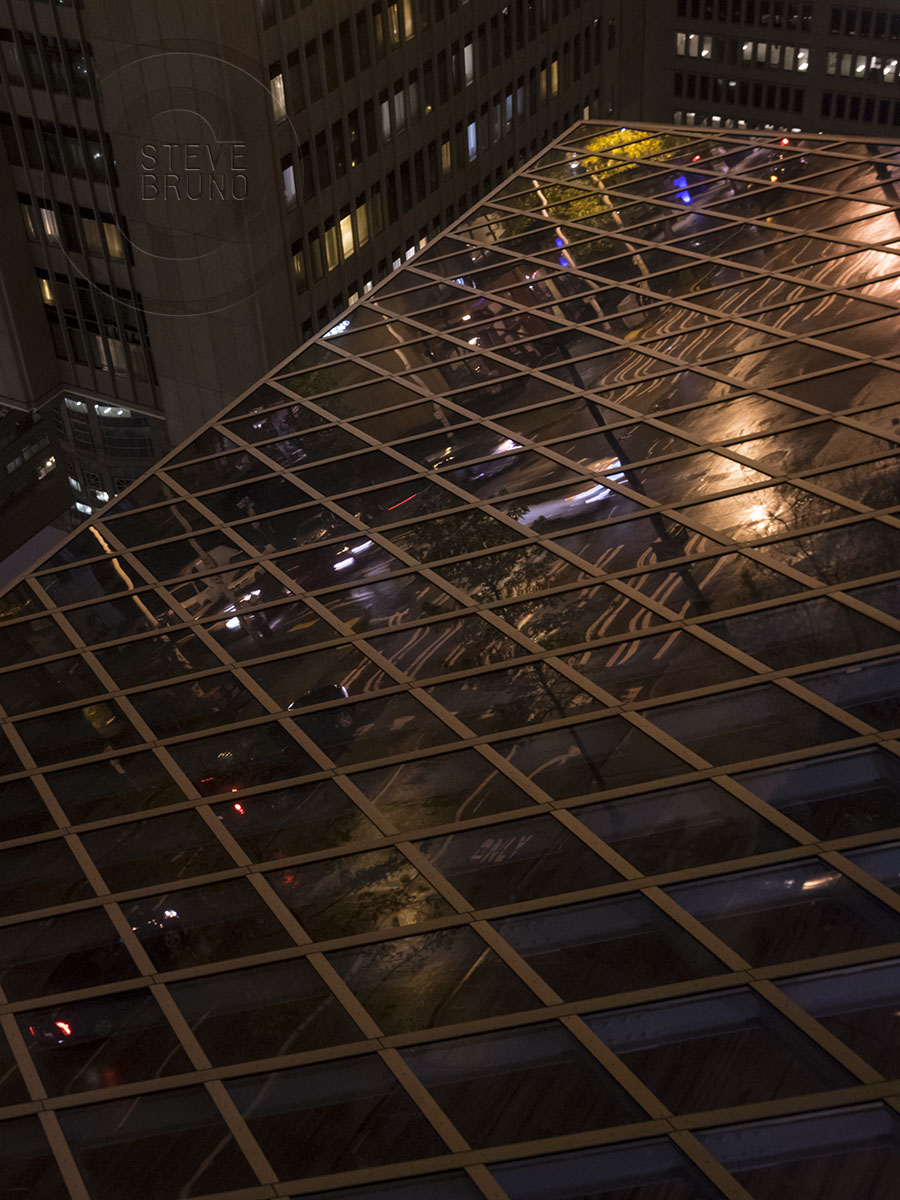
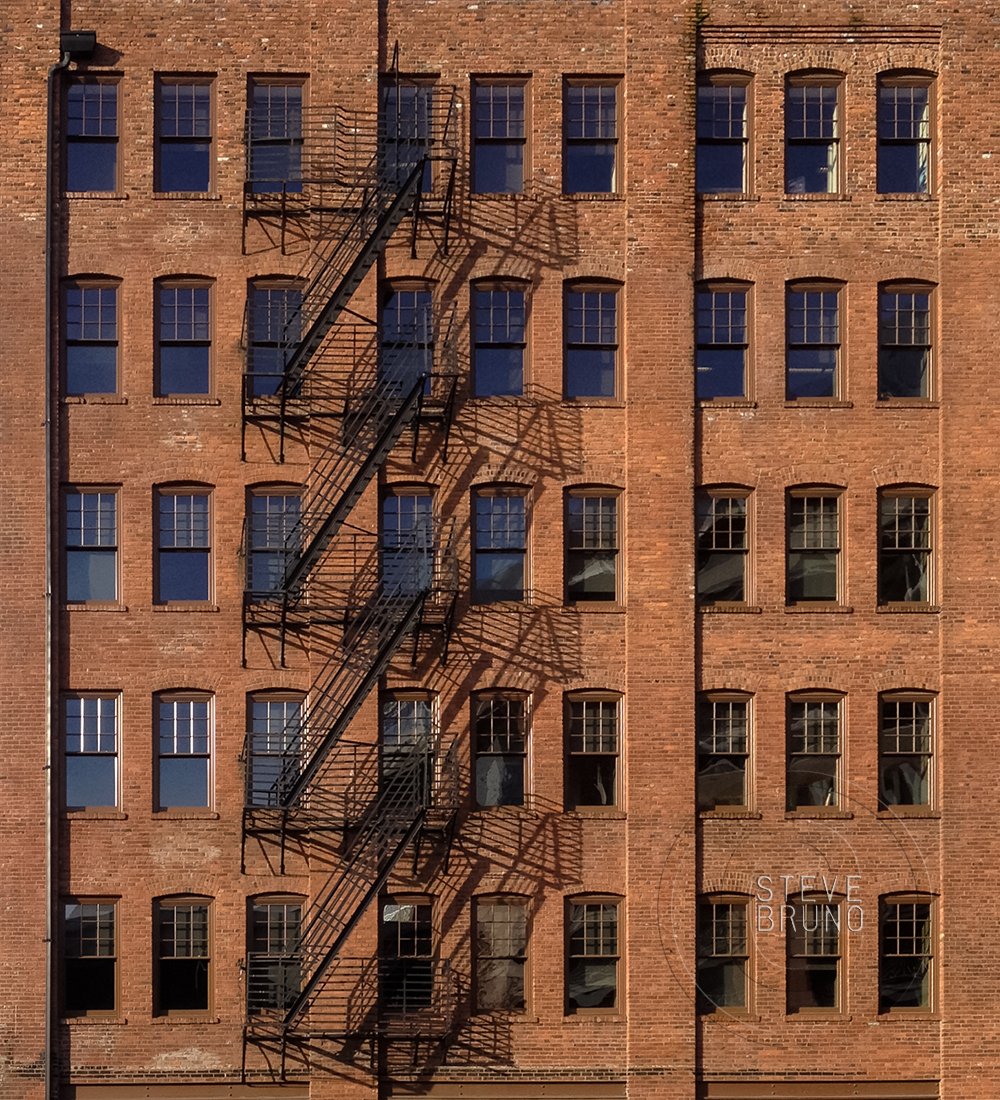
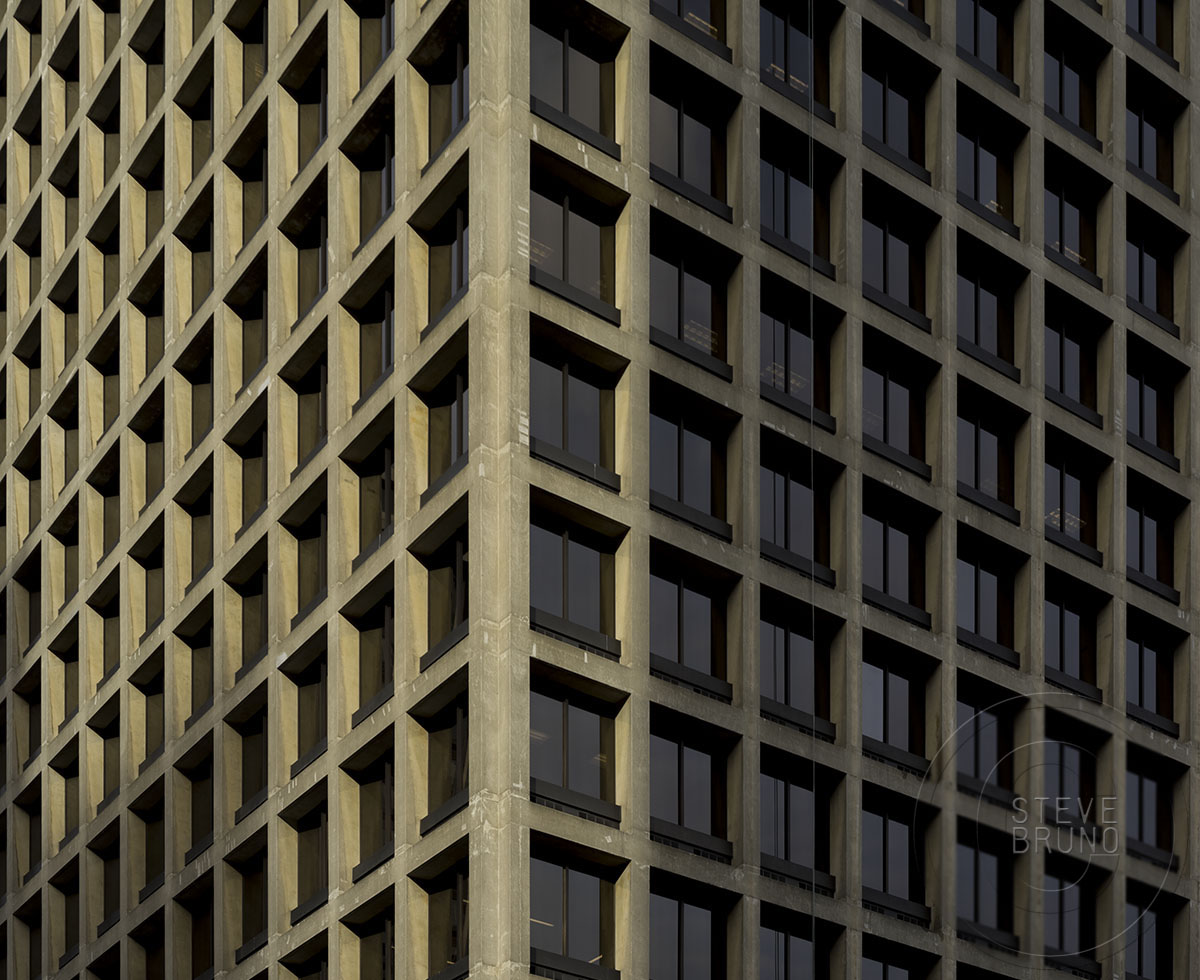
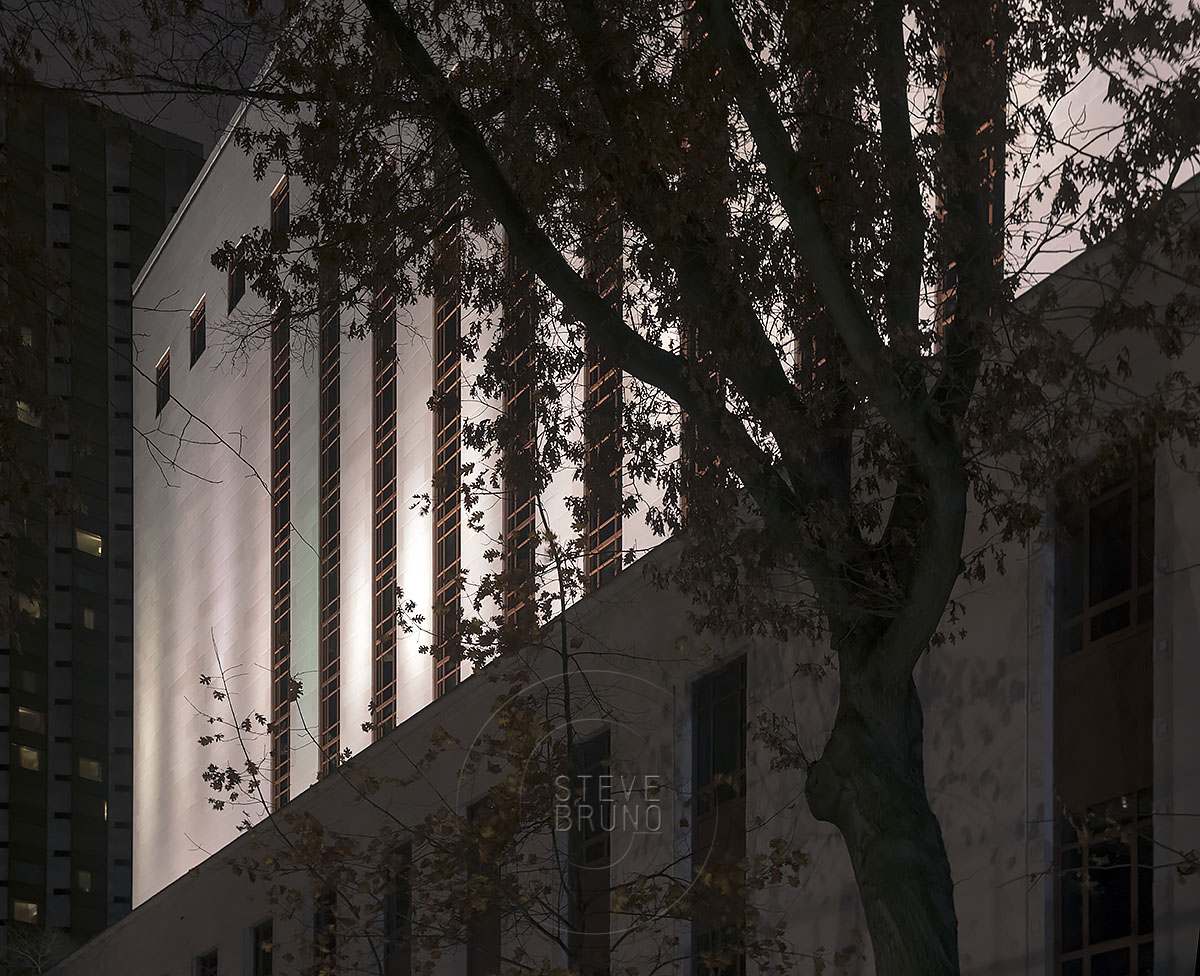
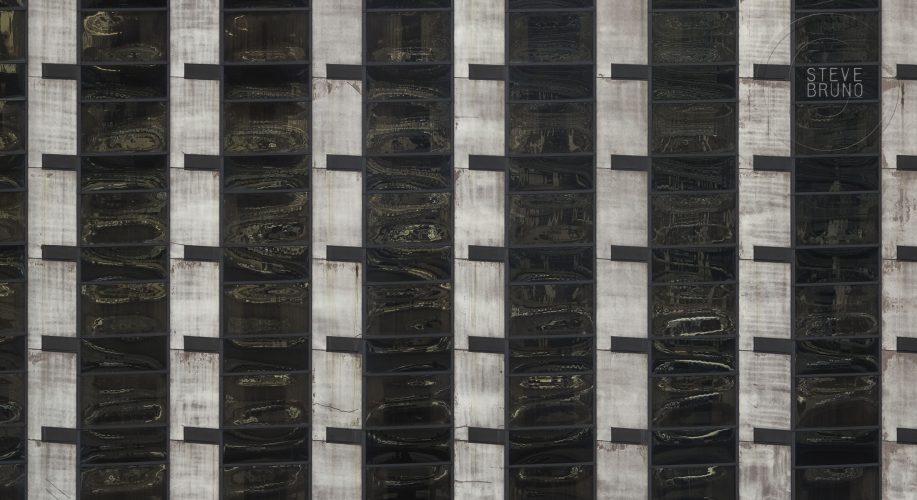
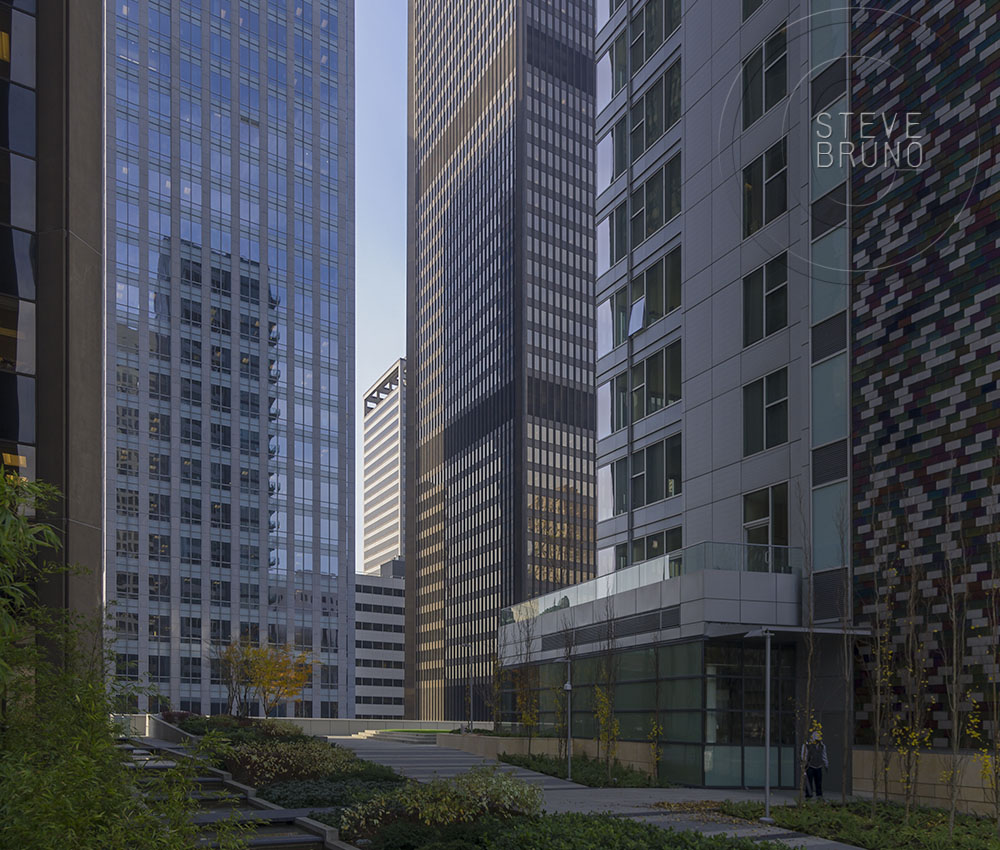
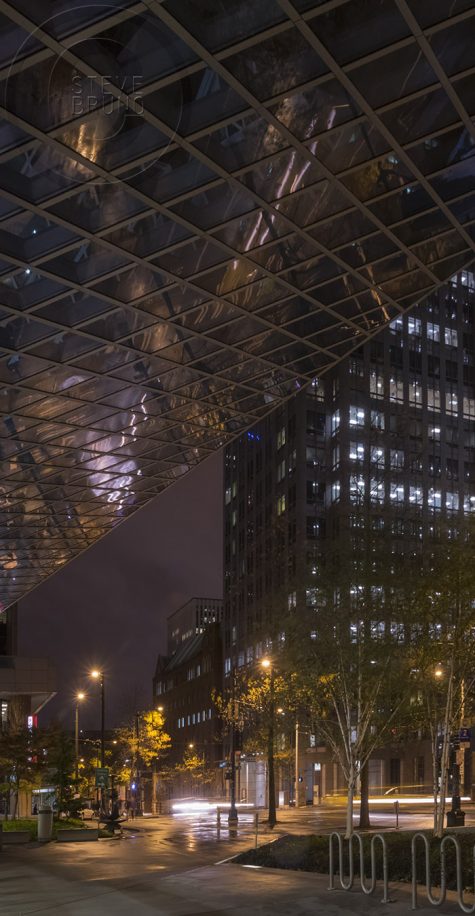
As I ventured around Seattle, I was fascinated with the patterns and textures of the buildings. Maybe that’s because I live in a city that lacks older genuine buildings. As with yesterday’s post, the lack of rain made all this possible.
Stairwells and shadows, Seattle.
Light and shadow coming together.
Court House building at night, downtown Seattle.
Distorted reflections in downtown Seattle building.
Squares and rectangles as far as one can see.
Seattle Library, looking other direction, and right side up.
The day before I headed off to Seattle, I checked the NWS forecast – Rain 100%, or Rain Likely every day. I didn’t think there would be much chance for photography, other than a few window seat shots (more on that to come). Oh, there was some rain, alright (see previous post), but there was much more time when it wasn’t raining.
I think the biggest surprise was that there was plenty of autumn color still. Much of the country has seen the leaves all go away, and this is when the lowest deserts are starting to peak. Somehow Seattle, despite being this far north, and despite all the rain and wind, manages to hold on to autumn.
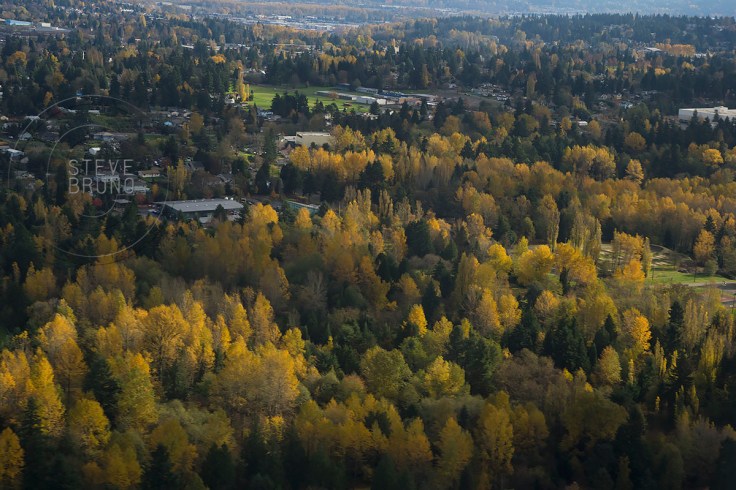
Autumn afternoon view from airplane landing in Seattle. Photo by Steve Bruno.
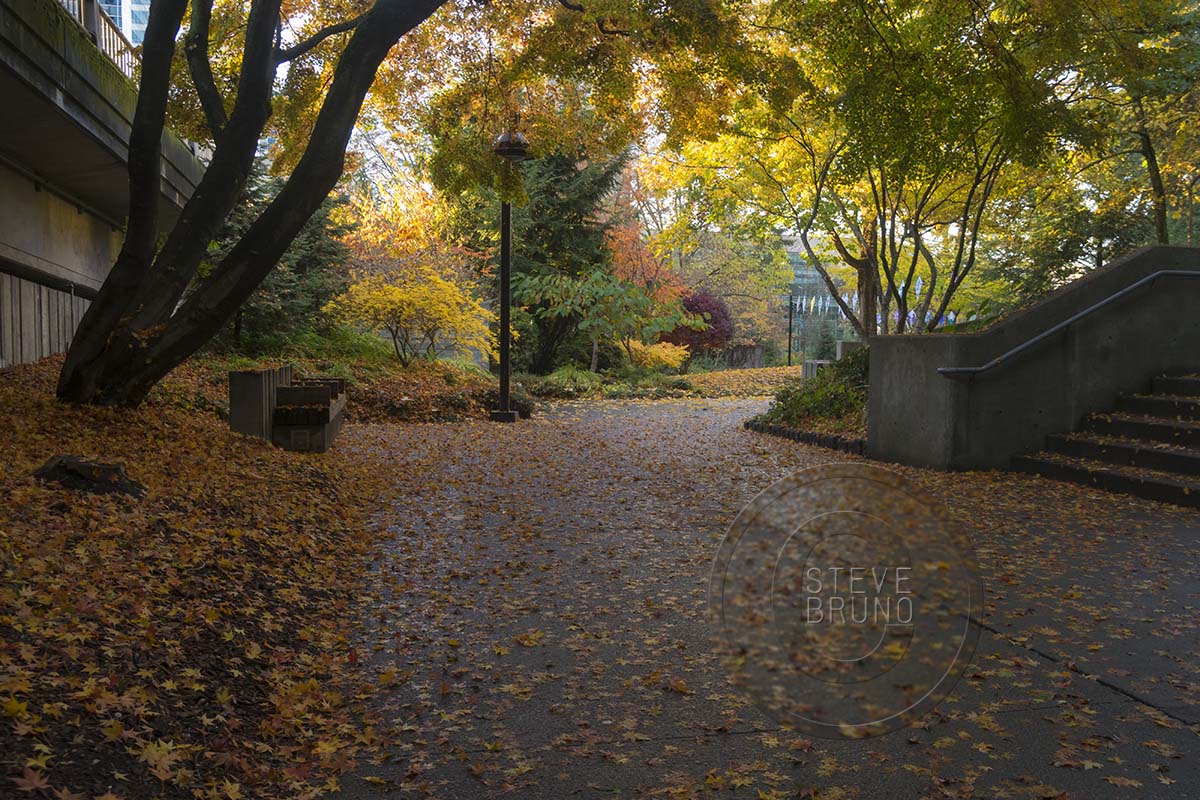
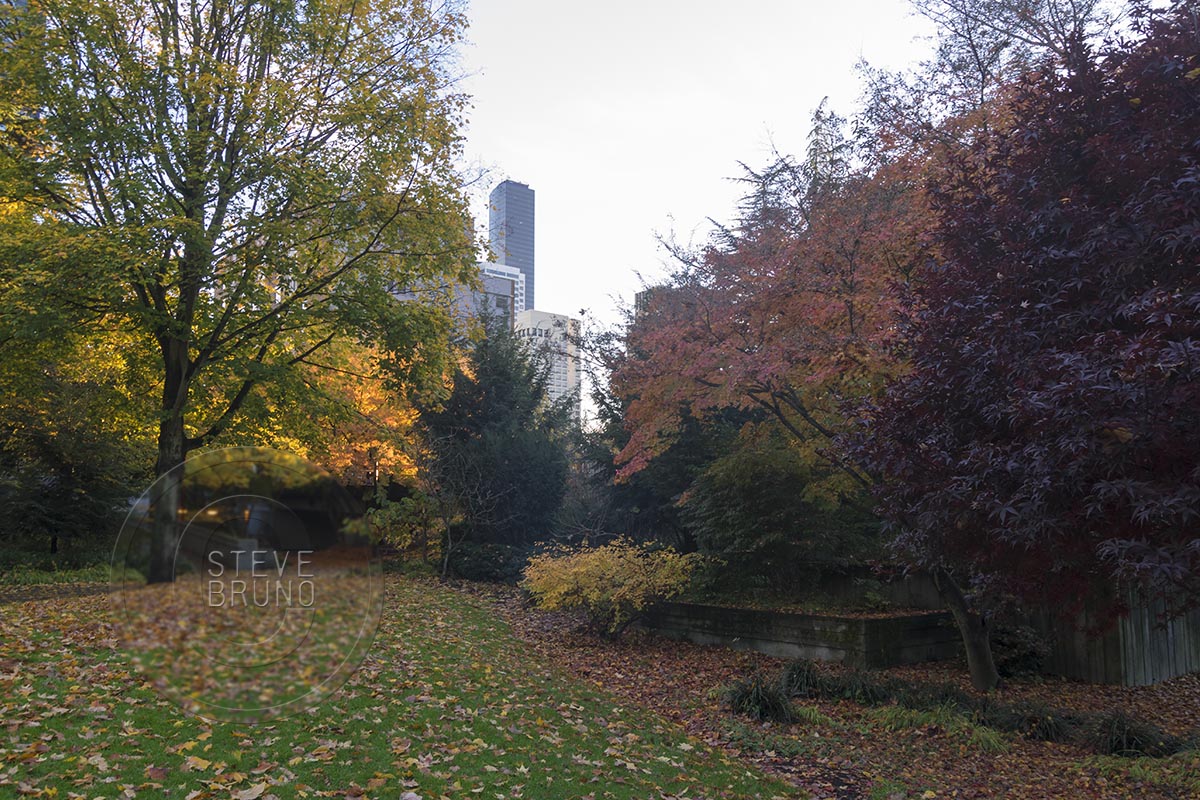
It was evident that I would have a reason to take my camera out before the plane even touched down. As soon as I was checked in, I grabbed my camera and started walking around. I saw a small group of trees amidst the tall buildings that were in various phases of changing color. I didn’t realize that I had stumbled upon Freeway Park. Appropriately named, the park sits above the freeway running through downtown Seattle. Many of the foliage shots I took were in this park.
Walkway through Freeway Park, Seattle. Photo by Steve Bruno.
Full range of autumn colors in Freeway Park, downtown Seattle. Photo by Steve Bruno.
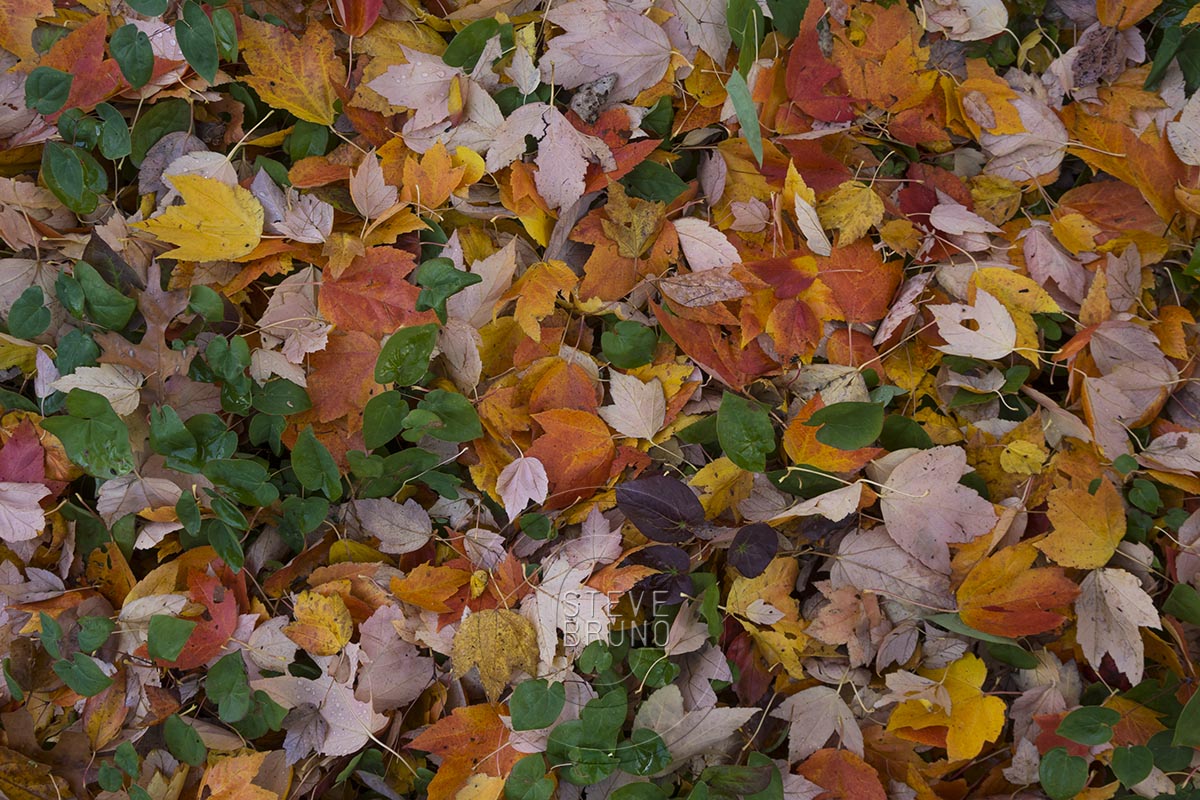
Fallen leaves mix with green vegetation in Freeway Park, Seattle. Photo by Steve Bruno.
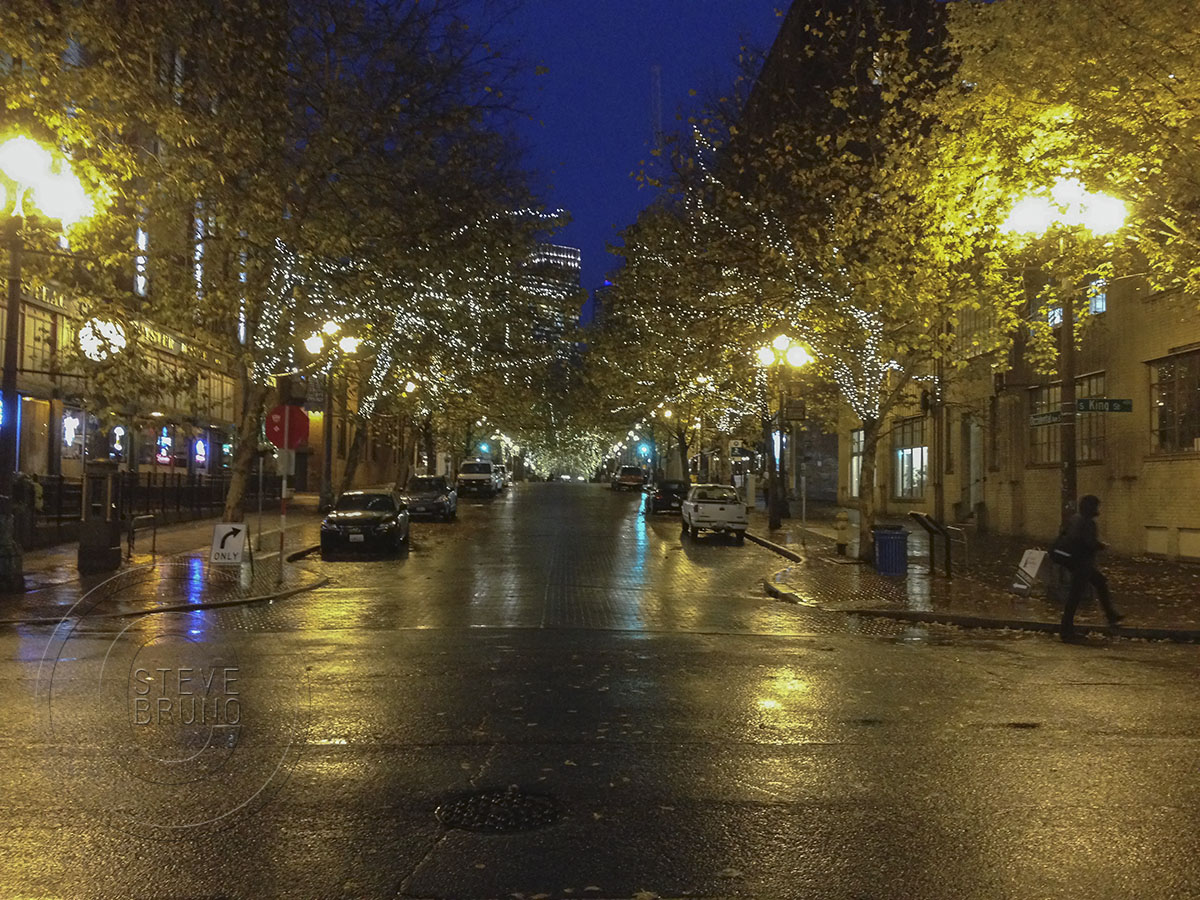
Autumn trees along city streets in downtown Seattle. Photo by Steve Bruno.
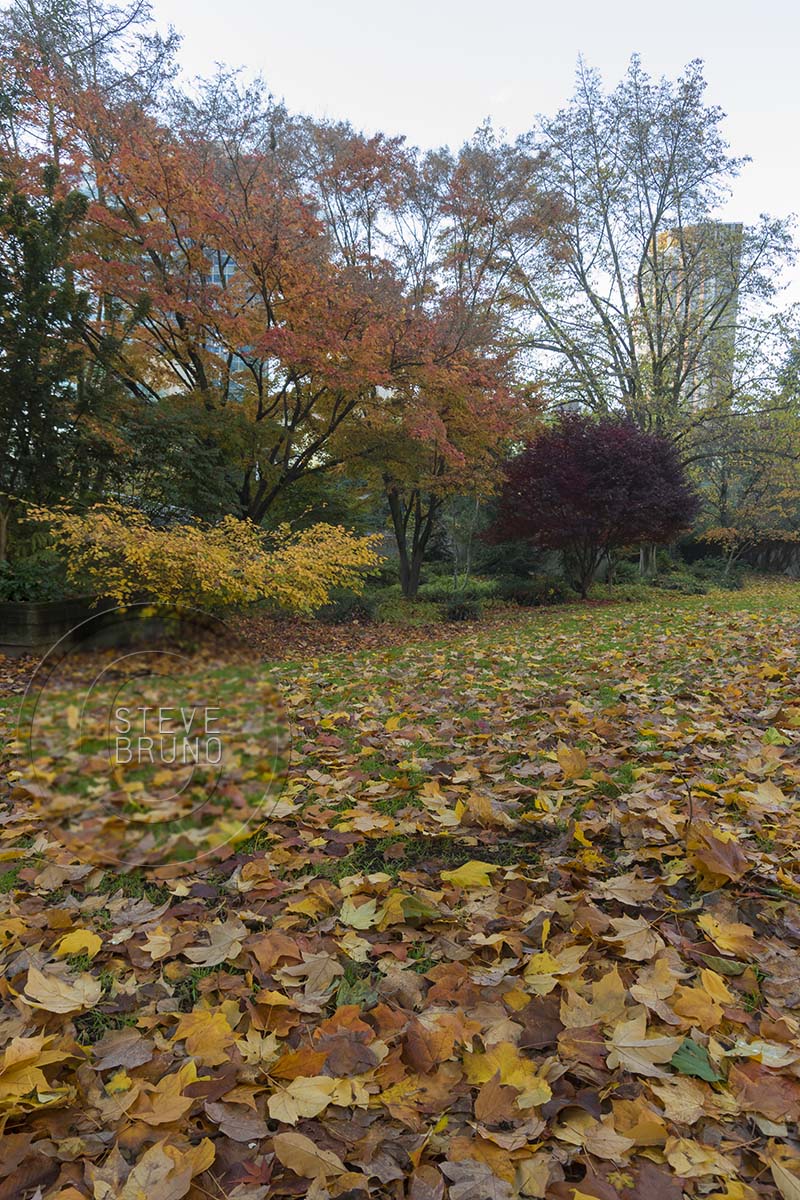
Autumn leaves cover the ground while some trees still hold on to their color in Freeway Park, Seattle. Photo by Steve Bruno.
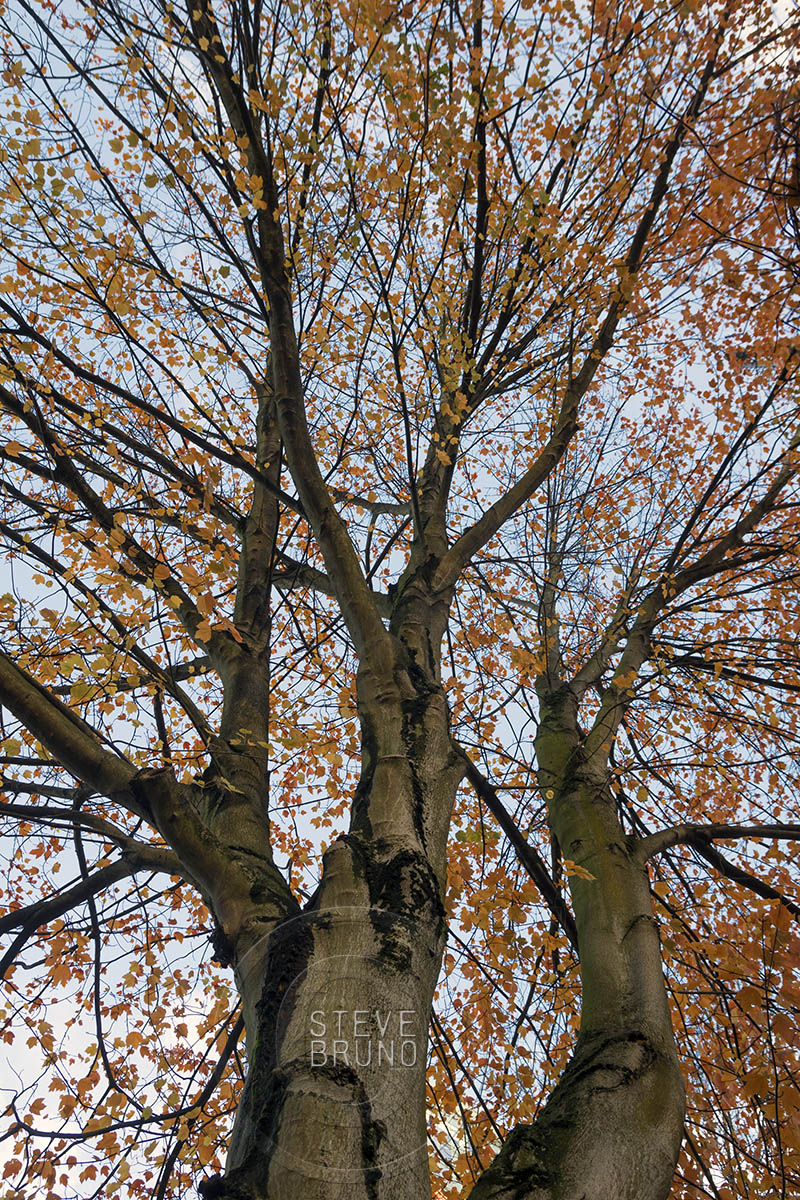
Tree branches reach skyward with the remaining leaves of autumn in Freeway Park, Seattle. Photo by Steve Bruno.
Most people think I’m crazy when I say I enjoy going to Seattle in November. And that’s before I tell them I also enjoy walking around in this weather. My attitude might be different if I spent months here, instead of just being a visitor. I grew up in the Midwest, and remember long periods of dismal weather, and from that experience, I also remembered how to dress appropriately.
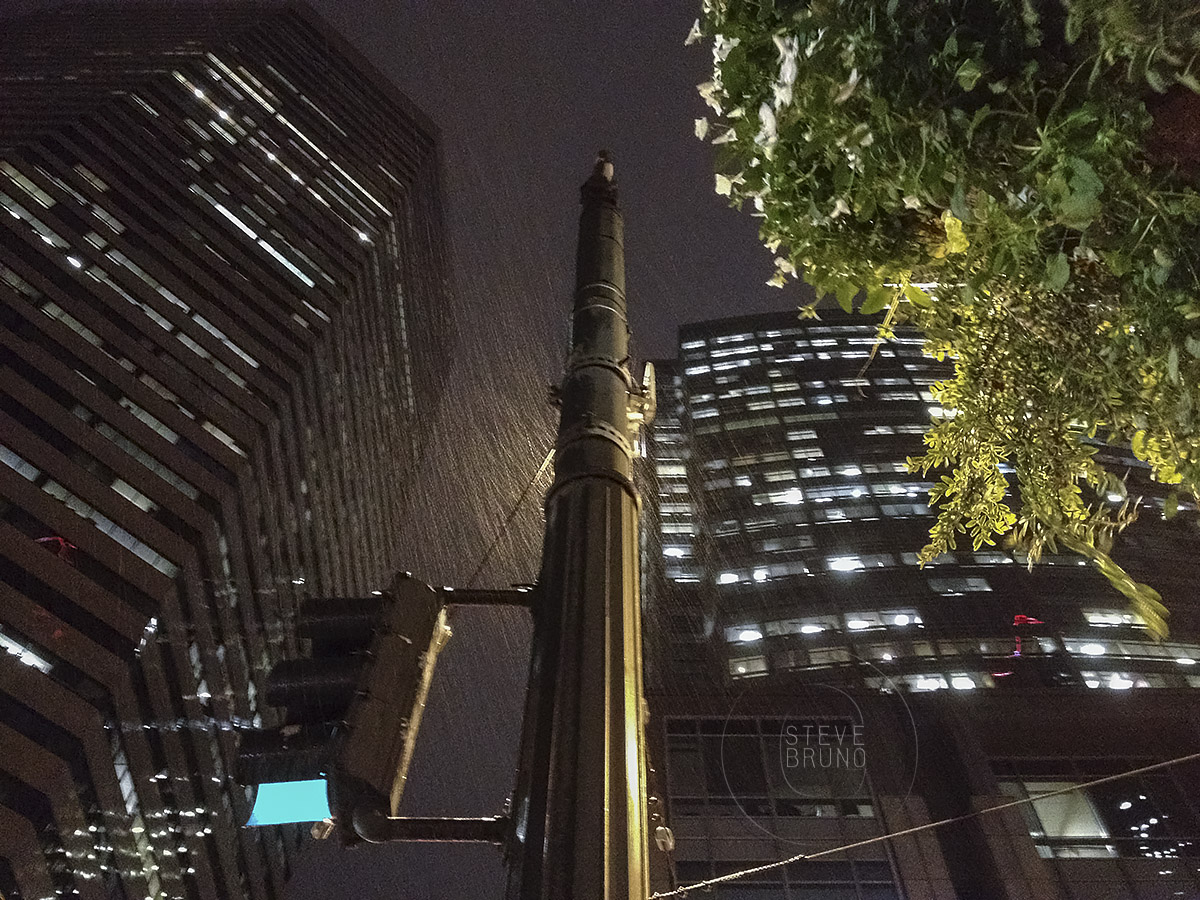
On this particular evening, I was walking around with just my phone in its Otterbox case. The rain was coming down at a substantial clip, even for Seattle. It rains much harder in the desert, but that’s usually for about five minutes. After I took the shot above, it occurred to me that I should head back to my hotel and grab my real camera. By the time I did, the rain had reduced to the standard drizzle. It never did rain again at night while I was here.
Pedestrian in the nighttime rain in Seattle. Photo by Steve Bruno.
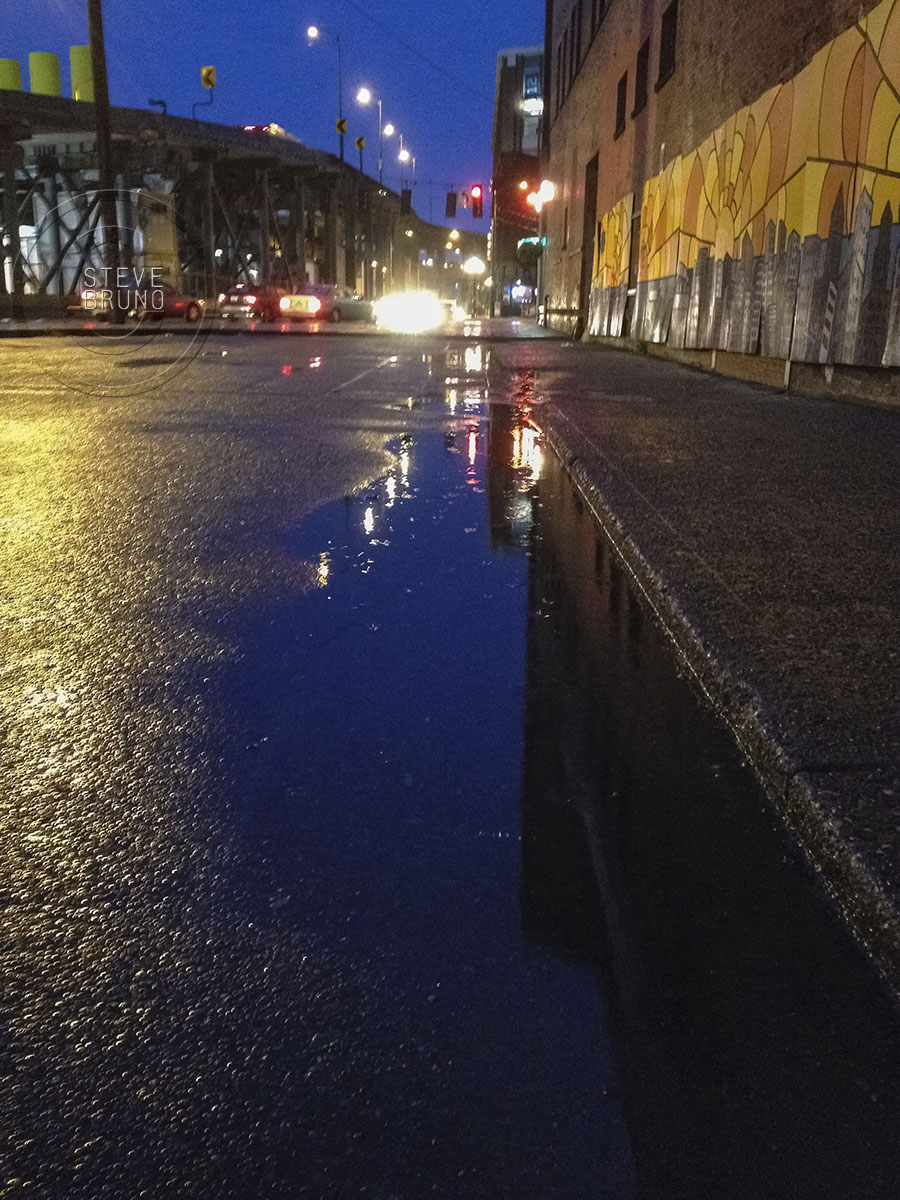
Rainwater starts to collect along the streets of Seattle. Photo by Steve Bruno.
When I’m flying, I spend most of the time with my eyes peering out the window, fixated on the shapes of the landscape only available through an aerial perspective. Every once in a while, it’s the clouds, not the land that captures my attention.
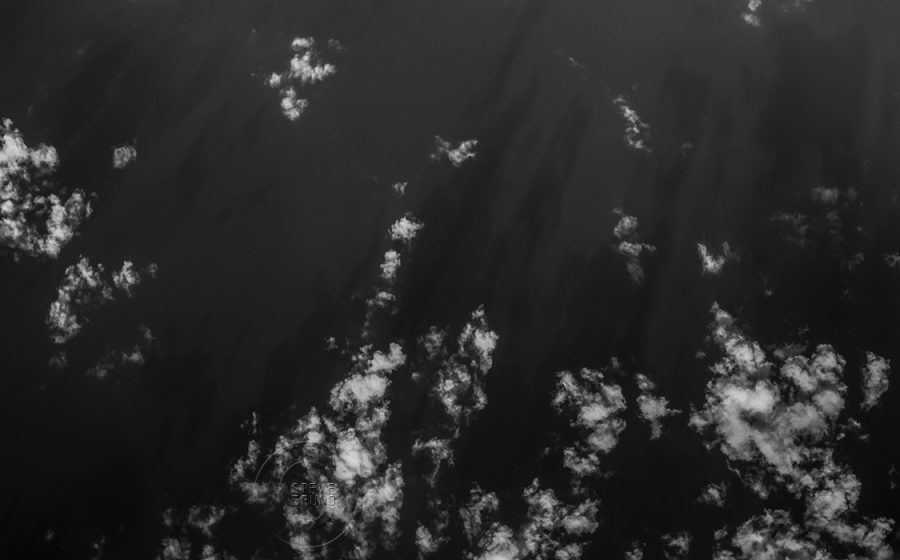
The photo above, was taken over the waters of the Gulf of Mexico. In the absence of any features of the land, the shadows of the clouds stretched uninterrupted across the open water in the late afternoon.
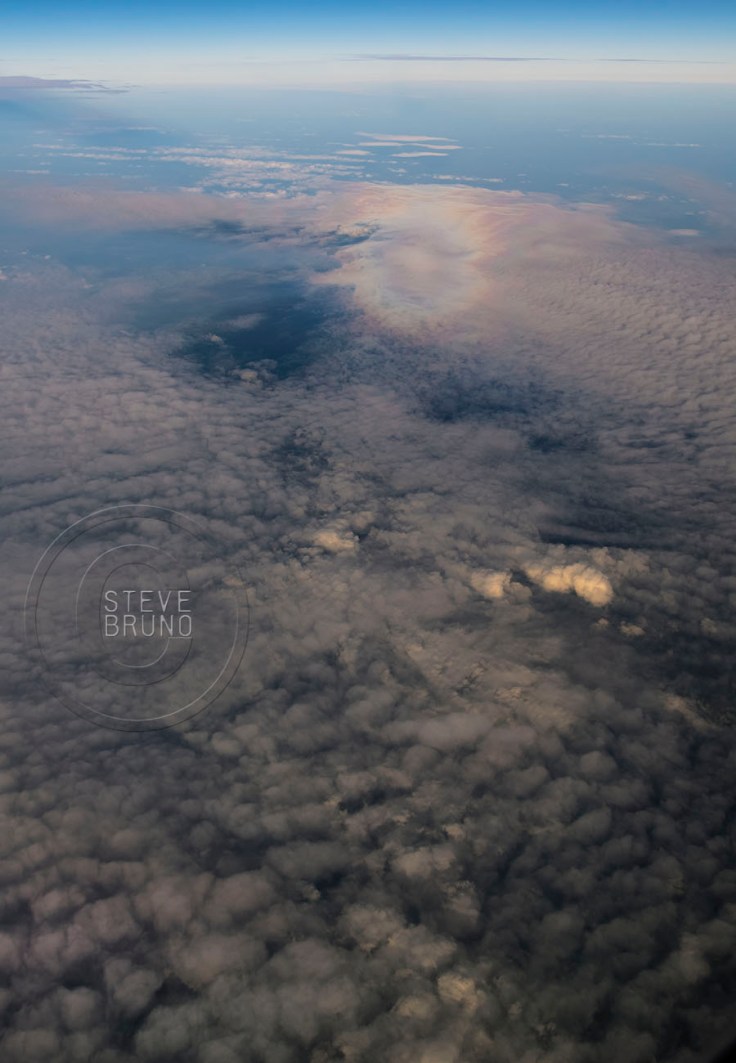
Also in a late afternoon setting, the plane had turned perpendicular to the line of the sun, allowing for this lighting pattern on the top of the cloud layer. I’ve seen this effect on takeoffs and landings emerging through low clouds, but not from this height.
Sunburst pattern on top of cloud layer. Photo by Steve Bruno.
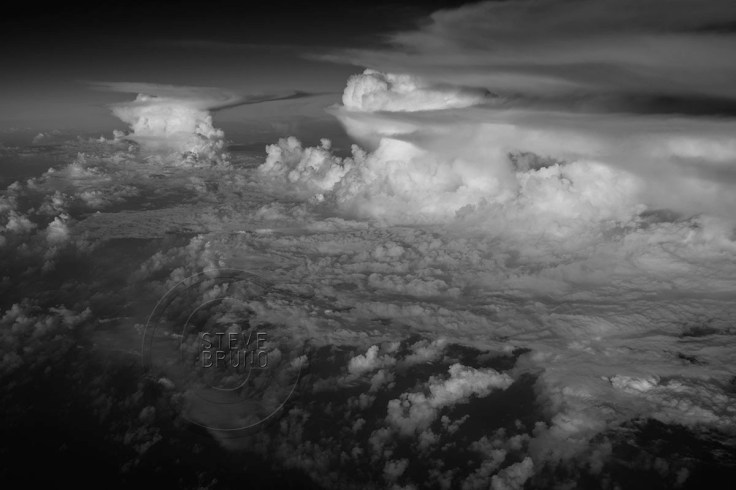
Then there are the occasions when cloud layers become prominent, creating a depth as rich as any landscape.
Multiple layers of clouds off the coast of Florida. Photo by Steve Bruno.
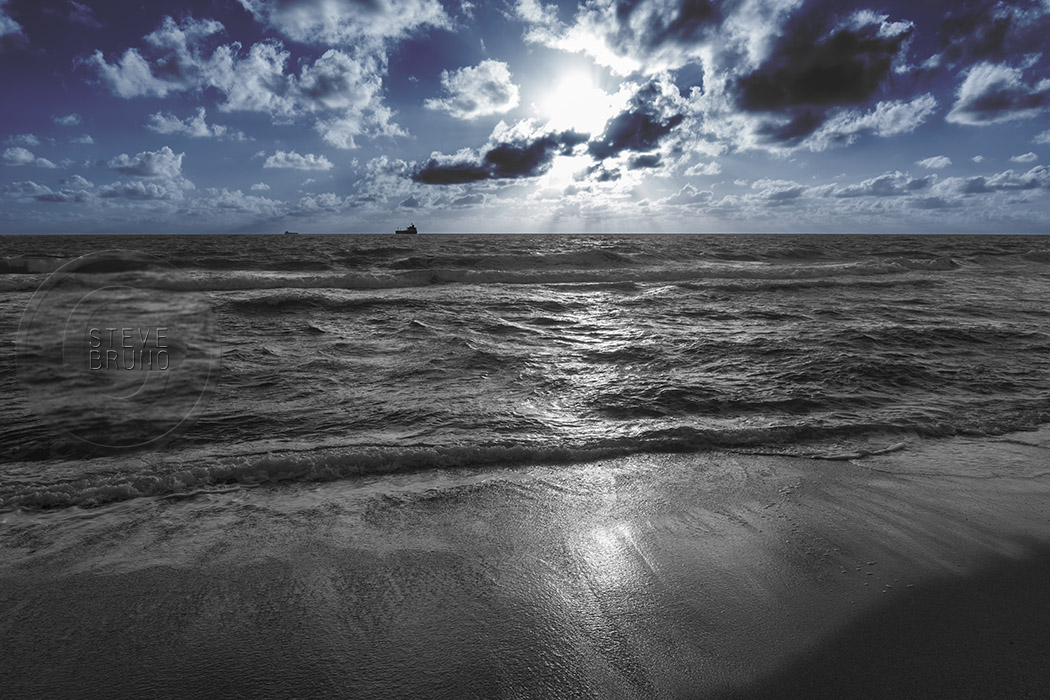
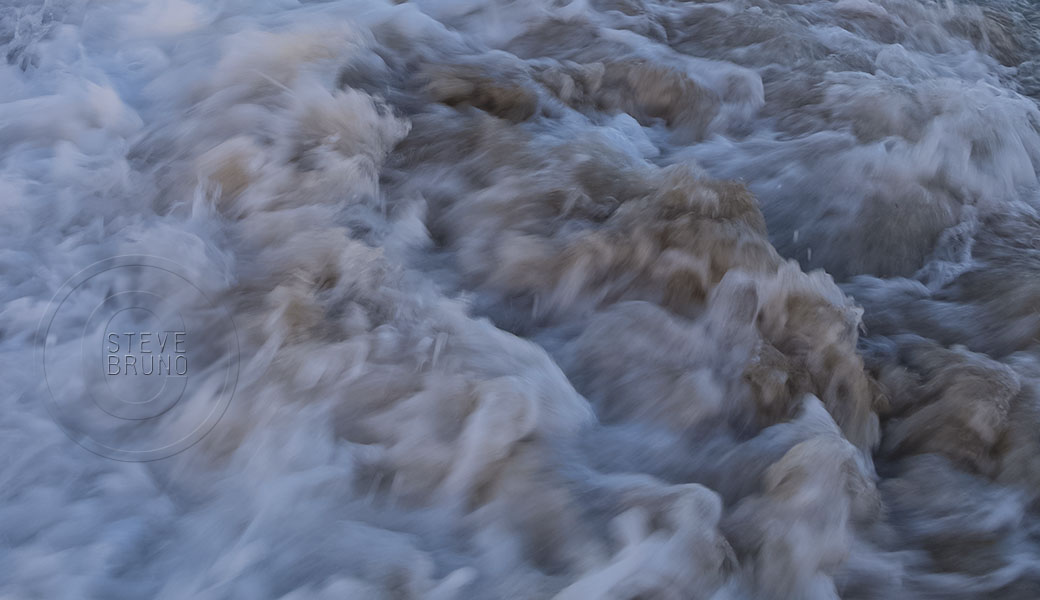
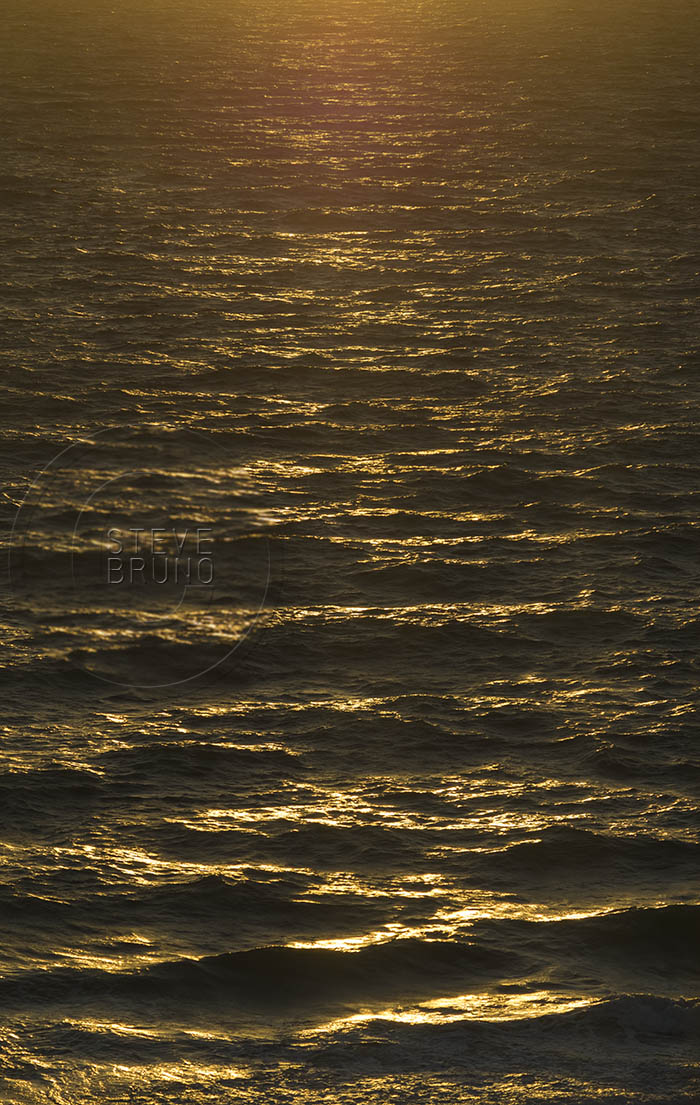
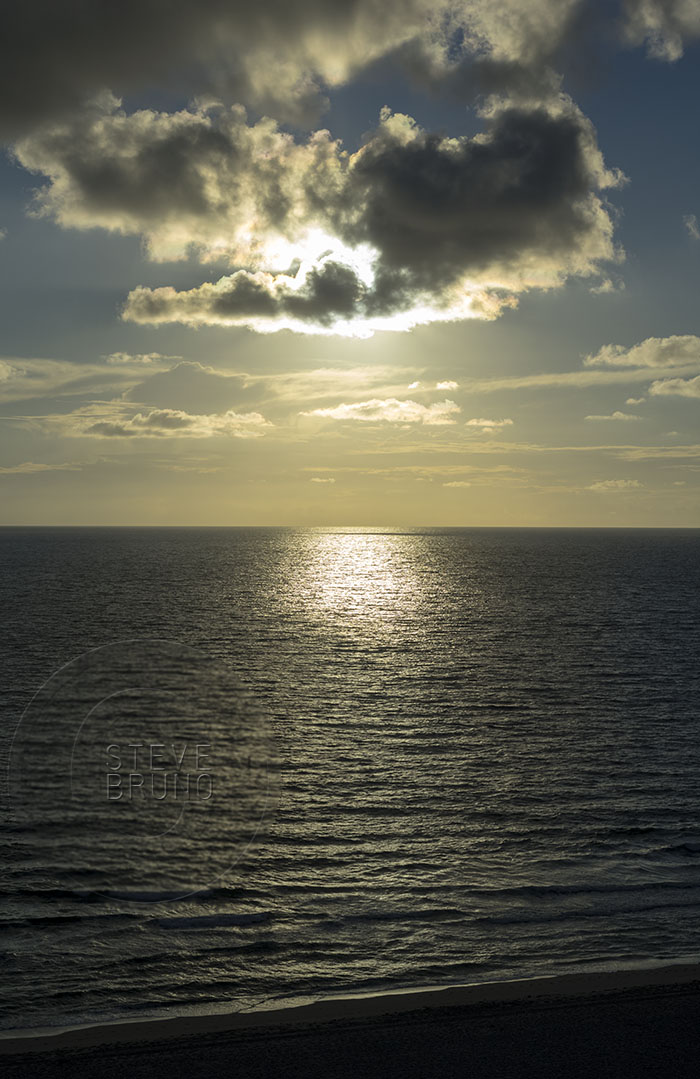
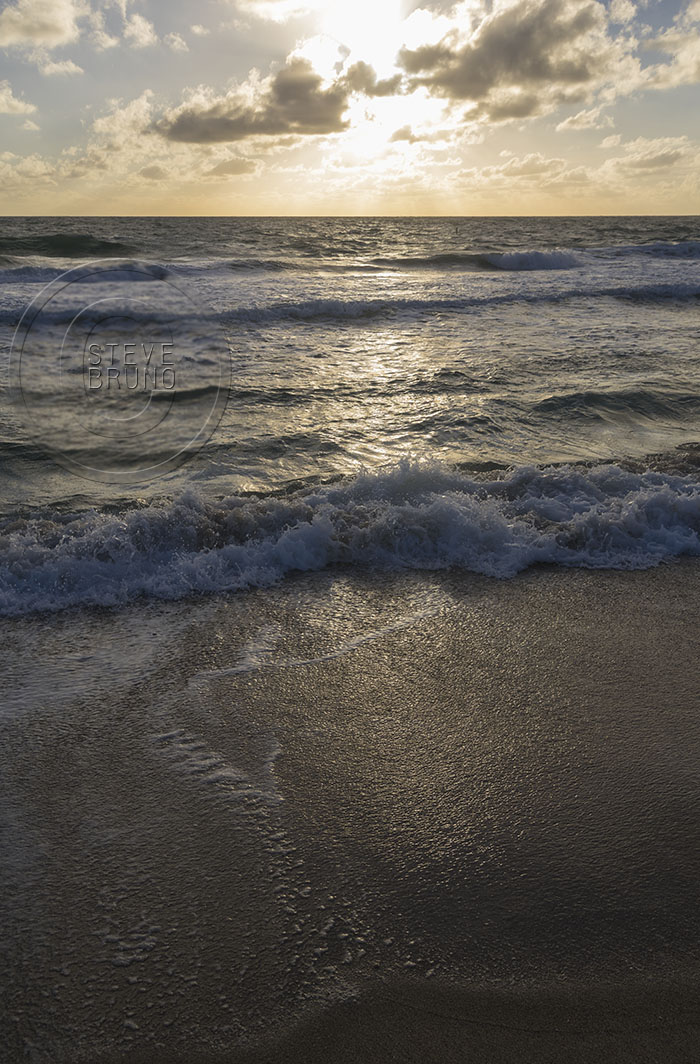
Last week I was in Florida again, and I had some time to try to capture images of the ocean. In many parts of the world, there are rock formations in the water or dramatic cliff backdrops, which offer more options for composition. The lack of any terrain made for more challenge, and the texture of the water became my primary focus.
In the top image, I converted it to b&w, and was mildly pleased with the result, but then decided to return the sky back to color in a new layer. I did make some minor cooling filter adjustments to the layer. I was about to remove the ship because I didn’t feel it was close enough to add to the scene, but then decided to leave it for its sense of scale.
I am often intrigued by other photographer’s shots of powerful waves crashing explosively into rocky shorelines, but I never knew there could also be interesting detail in a one foot high wave breaking onto a sandy beach. I’ve spent a lot of time using slow film in low light situations where blurred water results were common by default. A fast lens/high shutter speed combination allowed for detailed captures, and is something I will look for more often in future photo shoots.
Wave detail, Atlantic Ocean
Wave detail, Atlantic Ocean
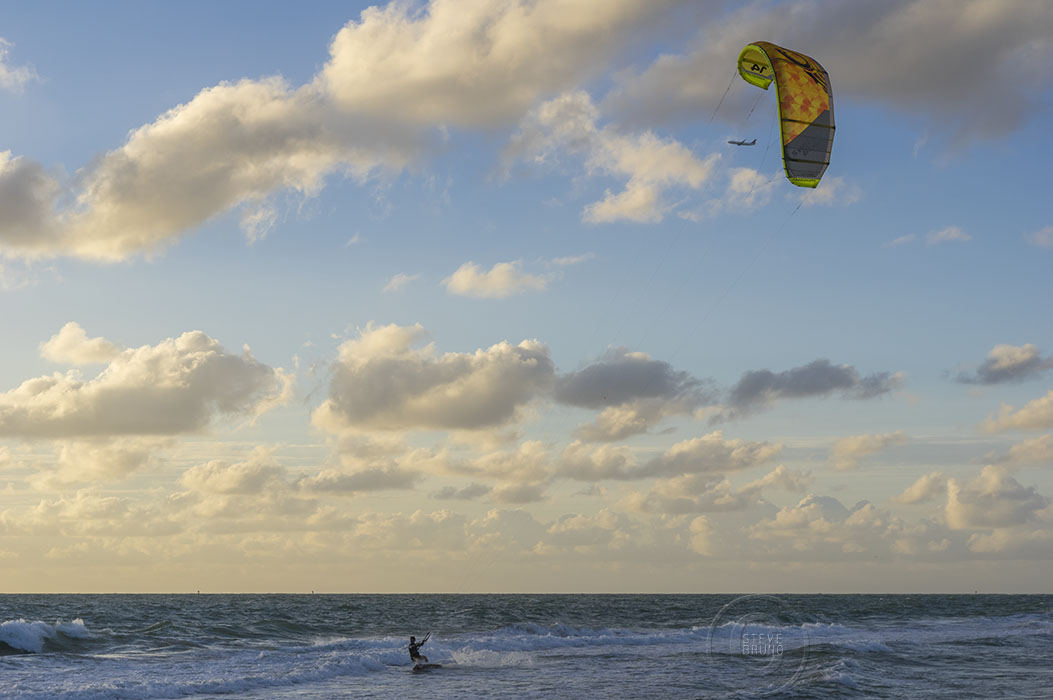
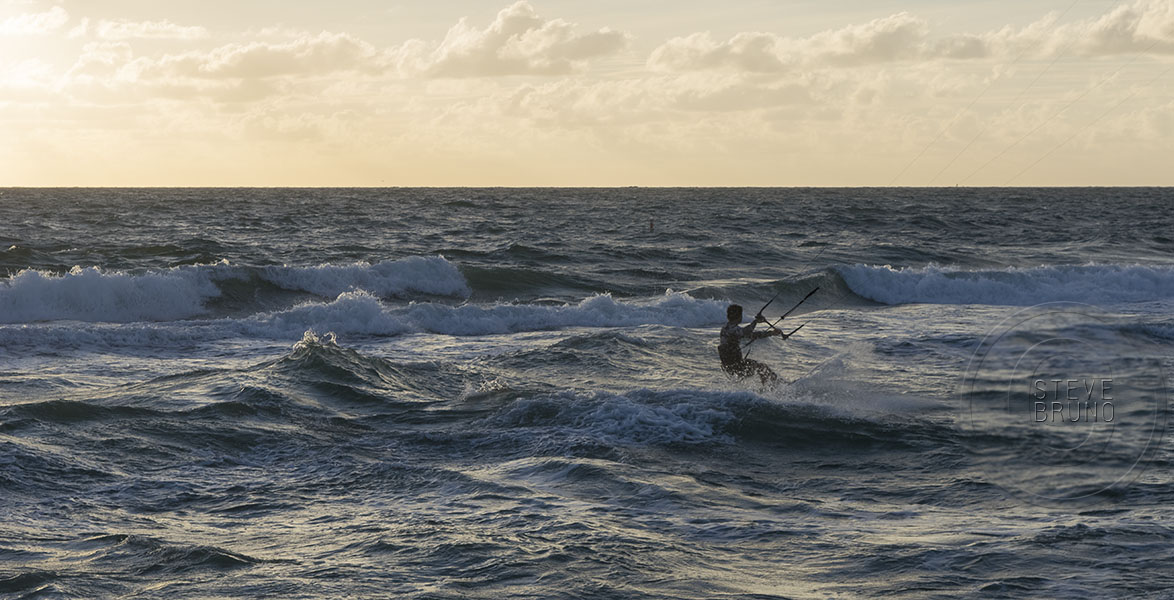
There was a significant amount of human activity, as one would expect. One morning, this paraboarder was getting his workout, making several passes along the beach in front of me. As I took one sequence of shots, a plane was taking off from the airport behind him. Around the same time, a tractor was making a clean sweep of the beach. The ocean is always busy churning out its natural waste, which doesn’t make for postcard beaches!
Paraboarder off the coast of Fort Lauderdale, Florida in early morning
Paraboarder off the coast of Fort Lauderdale, Florida in early morning
making the beach tourist friendly
In the end, the shots I liked the most occurred where there was texture on the wet sand or in the rolling water. One thing that doesn’t show up in the photos is the abundant humidity. The sea breeze made it enjoyable, but anywhere away from that was not pleasant. I’m very glad to be back in the desert now.










 Steve Bruno Photo
You must be logged in to post a comment.